





Cruise Deposit and Cancellation Rules: What You Should Know
Updated for 2026-2027 sailings. Deposit and cancellation rules differ by cruise line, fare, and promotion, so always confirm the exact terms in your booking before you pay.

Last updated Oct 22, 2026
Paying a deposit is the moment a cruise stops being an idea and becomes a commitment. The cabin is held, the clock starts on your payment schedule, and a set of rules decides how much money you can get back if your plans change. Many travelers only read those rules after something goes wrong. This guide explains how deposits work, when final payment is due, how cancellation penalties usually grow, and what to check before you book a cruise.
If you are new to cruising, start with our walkthrough on how to book a cruise for the first time, then come back here to understand the money side in detail.
By the end, you will know how to read a cancellation schedule, what questions to ask, and how to protect yourself if life gets in the way of your vacation.
On This Page
- What Is a Cruise Deposit?
- How Much Is a Cruise Deposit?
- Refundable vs Non-Refundable Deposits
- The Cruise Payment Timeline
- How Cruise Cancellation Rules Work
- What Happens in Common Situations
- Future Cruise Credit vs Refund
- Changing Your Booking Instead of Cancelling
- Price Drops After You Book
- Travel Insurance and Cancellations
- Deposits When Using a Travel Agent
- Flights and Other Bookings Around Your Cruise
- Common Mistakes to Avoid
- Before You Pay: Quick Checklist
- Plan Your Cruise With Vaavia
- Frequently Asked Questions
What Is a Cruise Deposit?
A cruise deposit is the first payment you make to hold your cabin on a specific sailing. It is usually a portion of the total fare, charged per person, and it secures your booking while you decide on the rest of your plans. The remaining balance is due later, on a date set by the cruise line.
Think of the deposit as the start of a contract. It tells the cruise line you intend to sail, and the cruise line promises to keep your cabin. The terms you agree to at this point, including the cancellation schedule, usually apply for the rest of your booking.
How Much Is a Cruise Deposit?
There is no single amount. Deposits vary by cruise line, cabin category, length of the voyage, and current promotions. Some factors that commonly affect the deposit:
- Cabin type: Suites and premium cabins often require a larger deposit than interior cabins.
- Length and destination: Longer or luxury voyages may require more money upfront.
- Promotions: Wave season and special offers sometimes include reduced deposits.
- Number of travelers: Deposits are usually charged per person.
Always ask what the deposit amount is, whether it is per person, and whether it can be changed to a different sailing if needed.
Refundable vs Non-Refundable Deposits
Not every deposit works the same way. The most important question to ask before you pay is whether the deposit can be returned and until when.
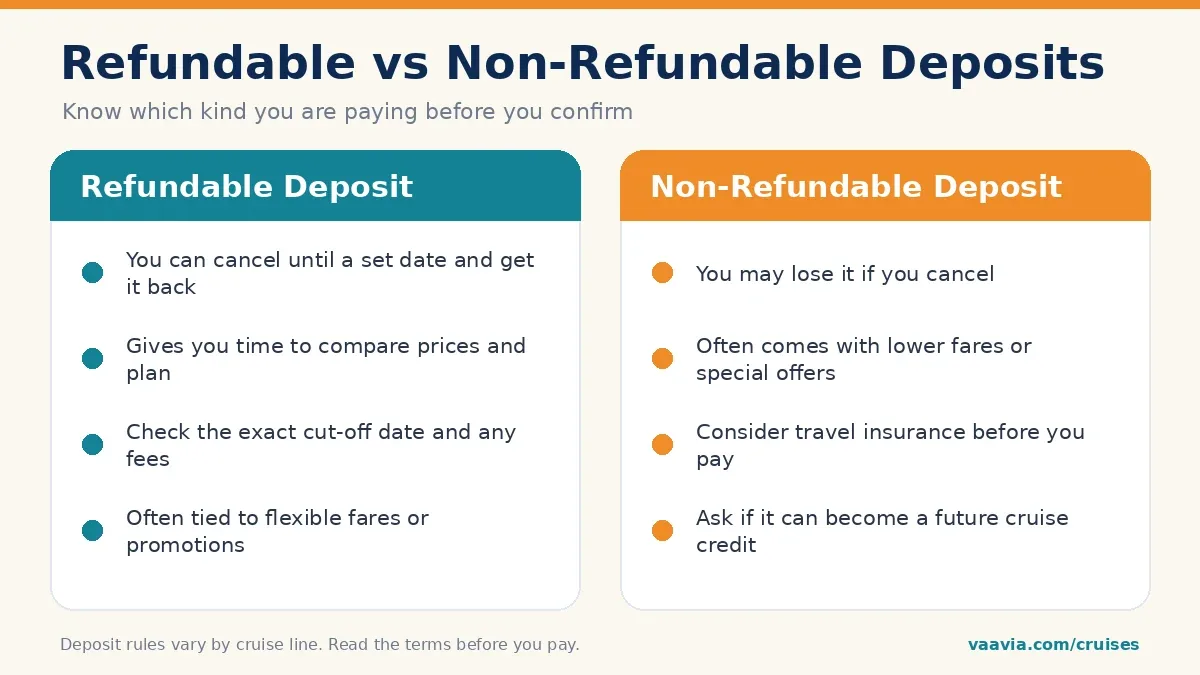
Refundable deposits can usually be returned if you cancel before a specific date. This gives you time to compare prices, confirm your vacation days, or wait for travel companions to commit. After the cut-off date, the deposit may become partly or fully non-refundable.
Non-refundable deposits are often tied to lower fares or special promotions. If you cancel, you may lose some or all of the deposit. In some cases, the cruise line may offer a future cruise credit instead, but this is not guaranteed.
Whichever type you choose, get the terms in writing and note the exact date when the rules change.
The Cruise Payment Timeline
A cruise reservation moves through several stages. The rules, and the cost of changing your mind, change at each one.
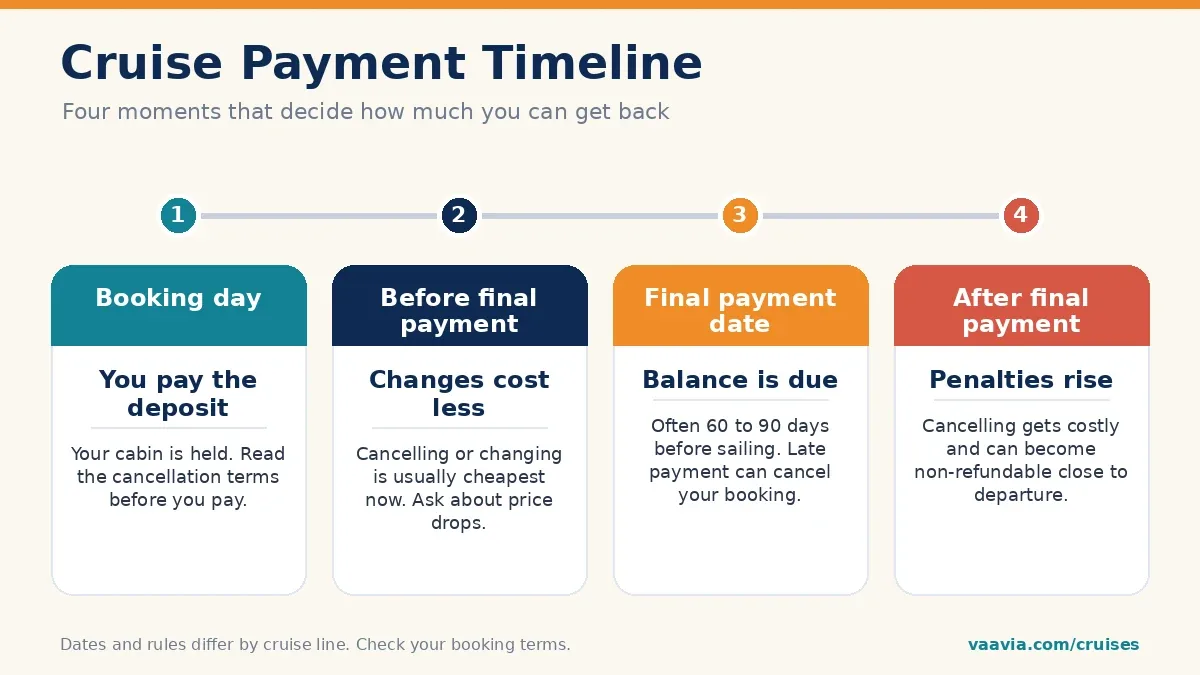
Booking Day
You pay the deposit and receive a booking confirmation. This is the best time to read the cancellation terms in full, since you have not yet committed the full fare. Save your confirmation email, booking number, and the names on the reservation in one safe place.
Before the Final Payment Date
This is usually the cheapest time to cancel or make changes. If your plans are uncertain, this window gives you the most flexibility. It is also the time to watch for price drops and to ask whether the cruise line will adjust your fare or add onboard credit.
The Final Payment Date
The remaining balance is usually due about 60 to 90 days before sailing, and sometimes earlier for longer or luxury voyages. Put this date in your calendar as soon as you book. If you miss it, the cruise line may cancel your booking and apply a penalty.
After Final Payment
Once you have paid in full, cancellation penalties become more serious. As departure gets closer, the amount you can recover usually shrinks, and in the last stretch before sailing the fare may become fully non-refundable.
How Cruise Cancellation Rules Work
Most cruise lines use a sliding scale. The earlier you cancel, the less you lose. The later you cancel, the more you lose. The exact percentages and time frames vary, so you need the actual schedule for your fare.
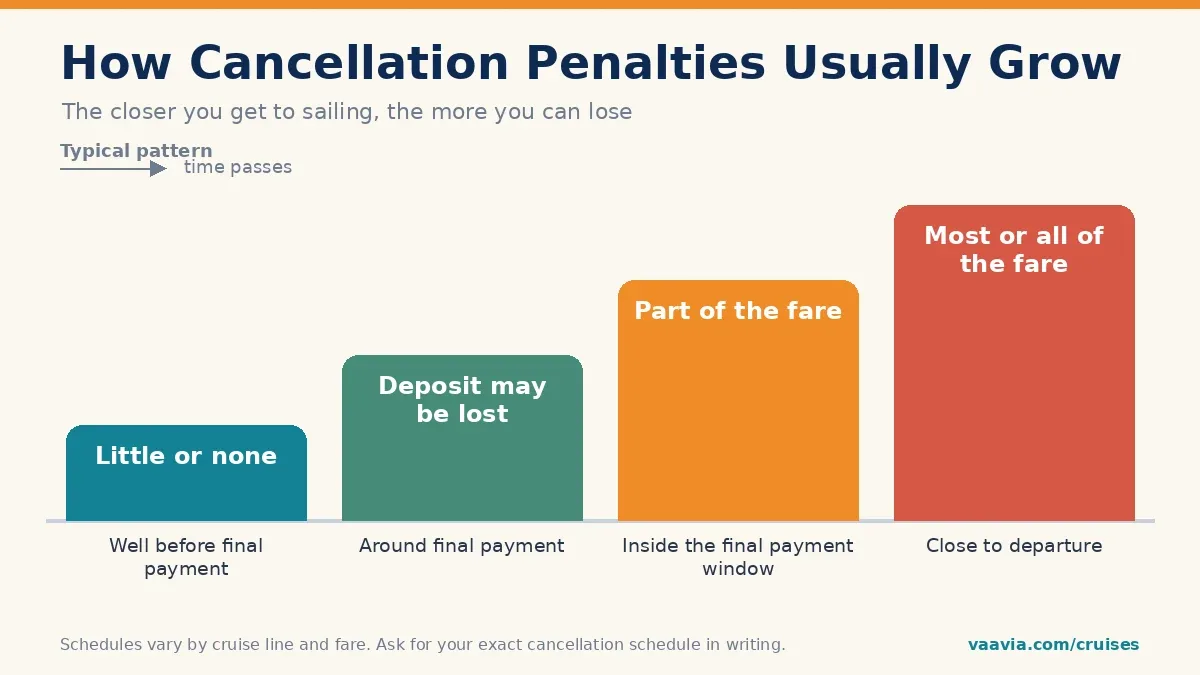
A typical pattern looks like this:
- Well before final payment: Little or no penalty, or the loss of part of the deposit.
- Around the final payment date: The deposit may be lost, and some of the fare may be charged.
- Inside the final payment window: A larger share of the fare is charged.
- Close to departure: Most or all of the fare may be non-refundable.
Treat this as a general pattern, not a promise. Ask the cruise line or your agent for the exact schedule that applies to your sailing and fare type, and keep a copy.
What Happens in Common Situations
| Situation | What Usually Happens | What to Do |
|---|---|---|
| You cancel well before final payment. | Often a small penalty or loss of the deposit | Cancel early and ask for written confirmation. |
| You cancel after final payment. | A percentage of the fare may be charged. | Check the schedule and ask about credit options. |
| You miss the final payment date. | The booking may be cancelled with a penalty. | Pay on time or contact the cruise line right away. |
| The cruise line cancels the sailing. | You are generally offered a refund or a future credit. | Ask about both and compare the value. |
| The itinerary changes significantly. | Rules depend on the cruise line and the type of change. | Read the notice and respond before any deadline. |
| You miss the ship. | The fare is generally not refunded. | Arrive a day early and consider insurance. |
These are general examples. Your booking terms are what count.
Future Cruise Credit vs Refund
Sometimes the cruise line offers a future cruise credit instead of returning your money. A credit can be useful if you are sure you will cruise again, but it comes with conditions.
Before you accept a credit, ask:
- Does the credit have an expiration date?
- Can it be used on any sailing or only certain ones?
- Is it transferable to another person?
- Can it be turned into a refund later?
- Does it cover taxes, port fees, and gratuities?
If you may not be able to use the credit, ask whether a refund is available, especially when the cruise line cancelled the sailing or changed it significantly.
Changing Your Booking Instead of Cancelling
Sometimes the best option is not cancelling at all. Many cruise lines allow changes to dates, cabins, or sailings, often with a smaller fee than a cancellation, especially if you ask early.
- Date change: You may be able to move to another sailing on the same itinerary. Availability and fare differences apply.
- Cabin change: Upgrading or downgrading depends on availability and price.
- Name change: Passenger names must match passports. A name correction is often easier early in the booking process, but some cruise lines charge a fee or limit changes close to sailing.
- Traveler changes: If a companion cannot travel, ask whether the booking can be adjusted without cancelling the whole cabin.
Ask before you cancel. A change can sometimes save a large part of the money you have already paid.
Price Drops After You Book
Cruise fares move constantly. If the price for your cabin drops after you book, some cruise lines will adjust your fare or offer onboard credit, usually only before final payment. Policies vary, and some promotions are not eligible.
Ask about price-drop policies when you book, and check your sailing's price every few weeks until final payment. If you see a lower fare, contact your cruise line or your agent right away. This is one of the easiest ways to save money after booking.
Travel Insurance and Cancellations
Travel insurance can protect part of your investment if you need to cancel for a covered reason. Policies differ, so read the details before you buy.
- Covered reasons: Many policies cover illness, injury, or other specific events. Not every reason is covered.
- Pre-existing conditions: Some policies have rules about these and may require you to buy soon after your first payment.
- Cancel-for-any-reason options: Some policies offer an optional upgrade that allows more flexibility, usually with a higher price and a time limit.
- Missed connections and delays: Some policies cover costs if a flight delay makes you miss the ship.
Compare what each policy covers, what it excludes, and when you must buy it. Keep the policy documents with your booking confirmation.
Deposits When Using a Travel Agent
A cruise travel agent or cruise booking agent can explain the deposit and cancellation rules and help you compare fares. Whether you pay the deposit to the cruise line or to the agent depends on how the booking is set up, so ask who receives your money and who handles changes and refunds.
Ask your agent for:
- The exact deposit amount and due date
- The cancellation schedule in writing
- The final payment date
- Any agency service fees
- Who to contact if you need to cancel or change the booking
A good agent should explain the rules clearly, not just the price.
Flights and Other Bookings Around Your Cruise
Your cruise is rarely the only thing you pay for. Flights, hotels, parking, and transfers all have their own rules, and they may be more expensive to cancel than you expect.
If your plans are uncertain, consider booking flights after your final payment date or choose refundable options. Check the airline refund policy and flight change rules before you pay. Plan to arrive at least a day before sailing, so a flight delay or a missed flight does not cost you the ship.
Common Mistakes to Avoid
- Not reading the cancellation schedule. Many travelers focus on price and skip the terms.
- Missing the final payment date. Add it to your calendar as soon as you book.
- Assuming every deposit is refundable. Check the type before you pay.
- Booking non-refundable flights too early. Wait until your cruise is paid in full, if you can.
- Skipping insurance on an expensive trip. It may protect you if you have to cancel for a covered reason.
- Mismatched names. Names must match passports exactly, and corrections can be costly.
- Cancelling without asking about changes. A date or cabin change may cost less than a cancellation.
- Accepting a credit without reading the conditions. Credits often have expiration dates.
Before You Pay: Quick Checklist
Ask yourself these questions before you confirm your cruise reservations:
- Is the deposit refundable, and until what date?
- How much is the deposit, and is it per person?
- When is the final payment due?
- What is the full cancellation schedule for my fare?
- Can I change the date, cabin, or name, and what does it cost?
- Does the cruise line adjust prices if the fare drops?
- Do I need travel insurance, and when must I buy it?
If you have clear answers to all seven, you are ready to book with confidence.
Plan Your Cruise With Vaavia
A good cruise booking is not only about finding a low price. It is about understanding the rules that protect your money. Ask for the deposit terms, mark the final payment date, and keep your cancellation schedule where you can find it.
Vaavia can help you compare cruise options, understand what is included, and find the right fit for your plans. Browse current cruises, or request a callback to talk through your questions with a booking specialist.
Frequently Asked Questions
What is a cruise deposit?
A cruise deposit is the first payment that holds your cabin on a specific sailing. The rest of the fare is due by the final payment date.
Is a cruise deposit refundable?
It depends on the cruise line, fare, and promotion. Some deposits are refundable until a set date, while others are non-refundable. Check the terms before you pay.
How much is a typical cruise deposit?
It varies by cruise line, cabin type, and promotion. Some offers include reduced deposits. Ask for the exact amount for your sailing.
When is final payment due?
Often about 60 to 90 days before sailing, and sometimes earlier for longer or luxury voyages. Your booking confirmation lists the exact date.
What happens if I cancel my cruise?
Most cruise lines use a sliding scale. You may lose little if you cancel early and much more if you cancel close to departure. Ask for the schedule for your fare.
Can I get a refund if the cruise line cancels?
You are generally offered a refund or a future cruise credit, but details depend on the cruise line and the reason. Ask about both options and compare them.
Can I change my cruise date instead of cancelling?
Often yes, subject to availability, fare differences, and any change fee. Ask as early as possible.
Is travel insurance worth it for a cruise?
Many travelers choose it because cruises are expensive and often non-refundable close to departure. Compare what each policy covers, including cancellation, medical care, and delays.