



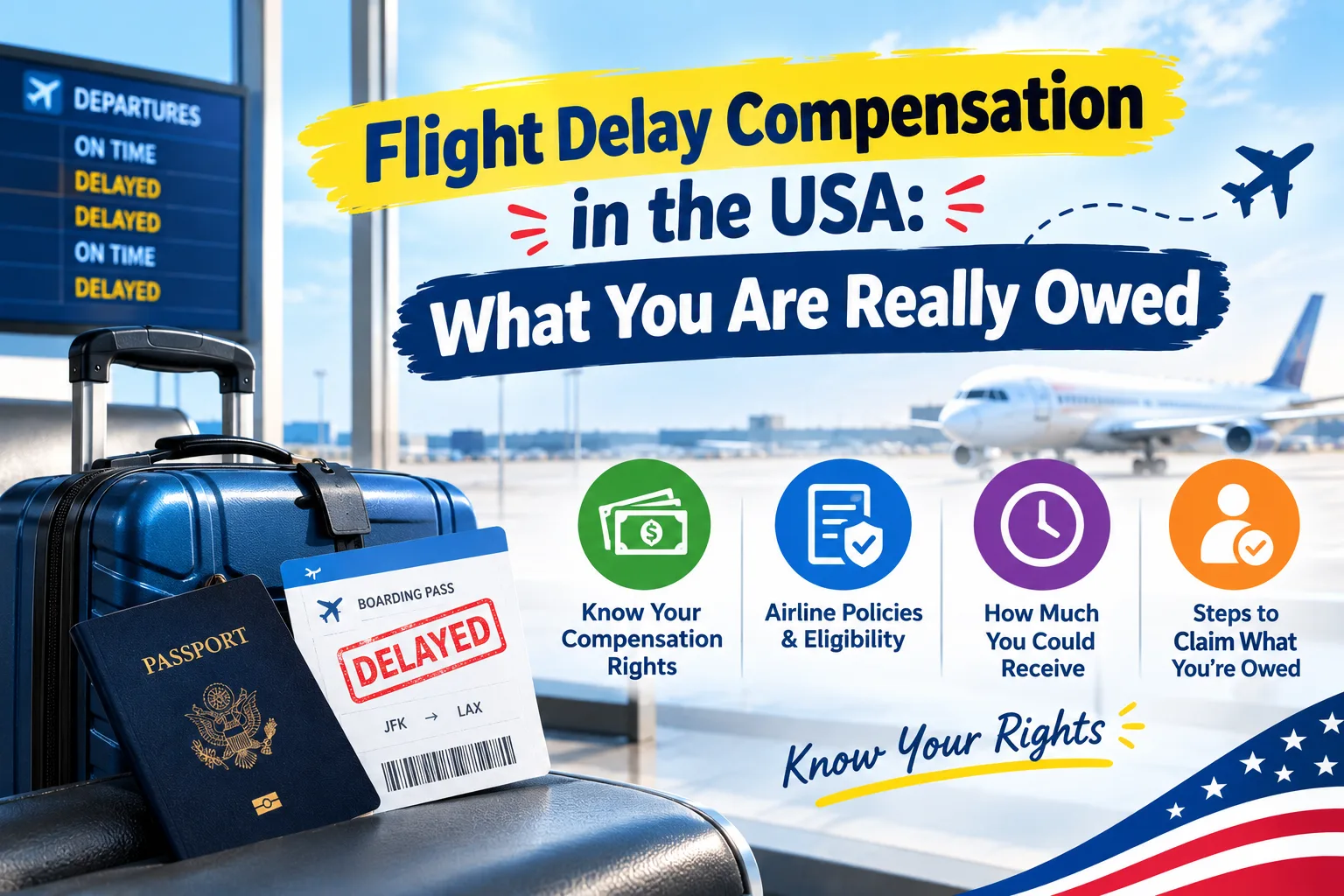
Flight Delay Compensation in the USA: What You Are Really Owed
No federal rule requires flight delay compensation when a U.S. domestic flight runs late or is canceled; the Department of Transportation withdrew its proposal to require it on November 17, 2025. What you receive comes from your airline's own published commitments. A refund when the airline cancels or significantly changes the flight is a separate right.
Last updated Oct 11, 2026
Does any rule require flight delay compensation in the USA?
No. No federal rule requires a U.S. airline to pay compensation when a domestic flight is delayed or canceled. The Department of Transportation proposed requiring it, then withdrew that proposal as of November 17, 2025. That holds however you bought the ticket: through our flight search, through a travel consultant, or from the airline itself.
Keep two words apart. A refund gives back money you paid for a trip you did not take. Compensation is something extra on top, paid because the disruption cost you time or trouble. U.S. rules require refunds in several situations and compensation in only one.
Compensation: Money or another benefit given to make up for a disruption, over and above anything you paid for the ticket.
So for most delayed domestic trips, federal law gives you nothing beyond a possible refund. What your airline chooses to offer is separate, and it is published in one public place.
What has your airline promised for delays it causes?
Airlines publish their own commitments for cancellations and delays within their control, and the Department of Transportation collects them on its airline customer service dashboard. It shows, carrier by carrier, what each one promises when the disruption is its own doing, and it also lists commitments to families flying with young children.
Controllable delay: A delay or cancellation the airline itself is responsible for, rather than one caused by something outside its control.
No federal rule dictates what those commitments must contain. Once an airline has listed one, though, the Department holds it to that promise. Commitments differ between carriers and change over time, so read the current entry for the airline operating your flight.
The Department also suggests asking airline staff whether they will cover a meal or a hotel, or compensate you for your time. Ask at the gate while the delay is live — a far better moment than a complaint form a week later.
Vaavia is an independent travel agency, not affiliated with any airline. The airline operating your flight sets and keeps these commitments; an agency cannot add to them.
When does a long delay mean you are owed a refund instead?
A long delay entitles you to a refund when the airline significantly changes or delays the flight and you decide not to travel. The same applies when the airline cancels and you turn down the alternative offered. What comes back is the money you paid, not a payment for the wait.
The Department of Transportation counts these as significant:
- A departure moved three hours or more earlier, or an arrival pushed three hours or more later, on a domestic flight — six hours or more on an international one
- A different departure or arrival airport
- More connections than you originally booked
- A move to a lower cabin that you did not choose
The decision not to travel is the catch. Board the delayed flight and the change counts as accepted, which closes the refund route. A downgrade is the exception: fly in the lower cabin and the fare difference is refunded.
Turn the offer down, or leave it unanswered, and the refund becomes automatic — seven business days for a credit card, twenty calendar days for any other method. Airlines must tell you the right exists. Where an agency took your payment as merchant of record, that agency owes the fare back, while the airline returns bag fees.
On a Vaavia booking, a refund that is owed returns by the method you paid with. The agency service fee is the exception: it stays with Vaavia once a booking is confirmed, even where the airline hands the fare back in full.
When does U.S. law actually require compensation?
In one situation: you are bumped from an oversold flight against your will. A few exceptions apply, and the amount owed is set by Department of Transportation rules, so read the official bumping and oversales page rather than a figure repeated secondhand.
Bumping: Being refused boarding on a flight you hold a confirmed seat on, because the airline sold more seats than the aircraft has.
Before anyone is bumped involuntarily, the airline must first ask passengers to give up their seats voluntarily in exchange for compensation. It has to tell volunteers whether they still risk being bumped involuntarily, disclose what would be owed if that happened, and spell out any restrictions on a voucher first.
So a request for volunteers at the gate is a negotiation, not a formality. Ask what is on offer, whether it arrives as a voucher and what limits it carries, and get the replacement flight confirmed before you hand over your boarding pass.
What should you do at the airport when a flight is badly delayed?
Collect facts and keep your options open, so you can decide before the new departure time arrives. These steps work in order.
- Ask why the flight is late. Check the airline app, then ask the gate agent for the cause and the new estimated time. Whether the airline caused the delay decides what its commitments cover.
- Record the times as they change. Screenshot every delay notice, write down each new departure time, and keep receipts for anything you buy while you wait.
- Read your airline's commitments. Look the carrier up on the customer service dashboard, then ask staff for whatever it lists for a delay inside its control.
- Ask what else is flying. Ask to be moved to another departure, including one on a later day. Have your booking reference and every traveler's name ready.
- Decide before you board. If the delay has become significant and the trip no longer works, ask for a refund instead of flying. Boarding ends that route.
- Follow up in writing. Write to the airline afterwards with your records attached. If the reply falls short of what it committed to, file a complaint with the Department of Transportation.
What do U.S. rules give you in each situation?
U.S. rules give you a refund in several situations and compensation in only one. The table lines up what went wrong against whether anything is owed.
| What went wrong | Is anything owed? | Where to look |
|---|---|---|
| Delayed flight you still choose to fly | No compensation required by federal rule | Your airline's own published commitments |
| Delay or cancellation the airline itself caused | Whatever that airline has publicly committed to | The airline customer service dashboard |
| Airline cancels and you refuse the alternative | A refund to your original payment method | The official airline ticket refunds page |
| Significant change and you choose not to travel | A refund to your original payment method | The official airline ticket refunds page |
| Checked bag significantly delayed on arrival | The bag fee refunded | The official airline ticket refunds page |
| Bumped against your will from an oversold flight | Compensation required by law, with few exceptions | The bumping and oversales page |
What are the most common mistakes travelers make after a delay?
The most common mistake is boarding the delayed flight and asking about a refund afterwards. Once you fly, the change counts as accepted and that route has closed.
- Expecting a payment for the wait. No federal rule requires one on a domestic delay; only an airline's own commitment can give you anything.
- Treating a voucher as the same as cash. Ask what restrictions it carries before you accept it — they have to be disclosed first.
- Throwing away receipts. A meal or hotel claim under an airline commitment needs the record most people never kept.
- Assuming a connection and a nonstop carry the same risk. Fewer connections mean fewer places for a delay to cascade, which argues for nonstop flights.
- Booking a non-refundable fare for a trip whose dates are not settled. Refundable flights behave very differently when a delay hits.
- Waiting weeks to raise it. Ask at the gate while the delay is live, then follow up in writing within days, not months.
Where should you go next after a delayed or canceled flight?
Go to whichever page matches what you need now: the refund route for a flight the airline canceled or changed, or the rebooking route if you still want to travel.
- Flight cancellation and refunds — what is owed when the airline cancels, and how the money reaches you.
- Flight changes and rebooking — moving a date or a route when the original plan no longer works.
A Vaavia travel consultant can read you the fare rules of a ticket before you commit to it, which is the right moment to learn what a disruption would cost you.
Sources
- Federal Register — Airline Passenger Rights; Withdrawal (2025)
- U.S. Department of Transportation — airline cancellation and delay dashboard
- U.S. Department of Transportation — airline customer service dashboard
- U.S. Department of Transportation — bumping and oversales
- U.S. Department of Transportation — airline ticket refunds
Frequently Asked Questions
Can I get compensation for a delayed domestic flight in the U.S.?
Not under federal law. U.S. airlines are not required to compensate passengers whose domestic flights are delayed or canceled, and the Department of Transportation withdrew its proposal to require it as of November 17, 2025. Your airline may still offer something under its own published commitments.
Is a refund the same as flight delay compensation?
No. A refund returns what you paid when the airline cancels or significantly changes your flight and you opt not to travel. Compensation would be an extra payment for the disruption itself, and for a domestic delay no federal rule requires one. Fly the delayed flight and the refund right generally ends.
Who do I complain to if my airline ignores its delay commitments?
Contact the airline first, in writing, with your booking details, the times of the delay and any receipts. If its answer does not satisfy you, file a complaint with the U.S. Department of Transportation, which holds airlines to the commitments they publish on its customer service dashboard.
Do I get compensation if I am bumped from an oversold flight?
Yes. U.S. law requires compensation when you are bumped against your will from an oversold flight, with a few exceptions. The airline must ask for volunteers first. Department of Transportation rules set the amount, so read its bumping and oversales page for what applies to your trip.
Should I volunteer to give up my seat on an oversold flight?
Only once you know the terms. The airline has to tell volunteers whether they still risk being bumped involuntarily, what would be owed in that case, and any restrictions on a voucher it offers. Confirm your replacement flight as well before you agree to anything.
What should I keep as proof during a long flight delay?
Screenshot every delay notice with its timestamp, note the original and revised departure times, and keep receipts for meals, transport or a hotel room. Record what staff told you and when. A claim under an airline commitment stands or falls on that record.