



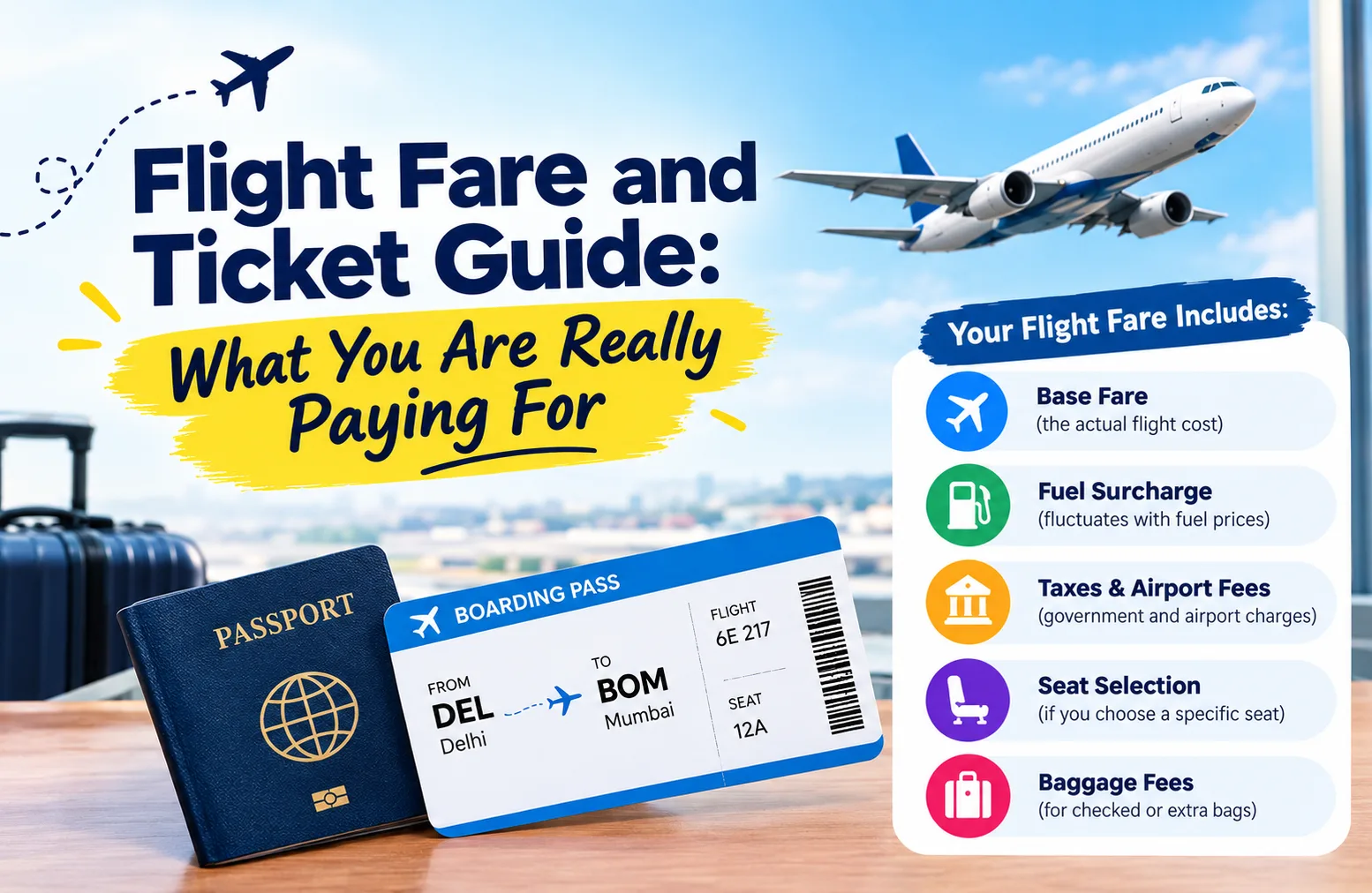
Flight Fare and Ticket Guide: What You Are Really Paying For
This flight fare and ticket guide explains what you buy when you buy a seat: a base fare the airline sets, taxes and charges collected alongside it, an agency fee where one applies, and a fare class whose rules decide every change afterwards. The ticket itself is a record in a system, not a piece of paper.
Last updated Oct 11, 2026
What does this flight fare and ticket guide cover?
It covers four things: the parts that add up to the price you pay, the fare class behind that price, the codes that identify your reservation and your ticket, and the checks to make before paying.
A ticket is a record held in an airline's system, not the email in your inbox. That record shows a seat was paid for, names the traveler, lists the flights in order, and carries the rules the fare was sold under.
E-ticket: An e-ticket is the electronic ticket record an airline stores when a seat is paid for, in place of the paper coupon book airlines once issued.
The price has several owners, which is why a canceled trip can return some lines of a receipt and none of the others. The airline sets the fare and its own charges, public bodies set the taxes and airport fees, and an agency sets its fee. The question to ask about a charge is not how large it is but who set it, because that is who decides whether it comes back.
Vaavia is a trading name of Worlds Travel, an independent travel agency in Dover, Delaware, not affiliated with any airline. Its service fee applies per confirmed booking, is shown before payment, and is not returned once the booking is confirmed, even where the airline later refunds the fare.
What is a fare class, and why do two seats in one cabin differ?
A fare class is the airline's code for the exact terms a seat was sold under, so two travelers in neighboring seats can hold entirely different tickets.
Fare class: A fare class is a letter code an airline attaches to a seat to record which fare rules, change terms and loyalty earning apply to that particular ticket.
The letter rides on an itinerary beside the cabin name. Cabin tells you where you sit; fare class tells you what you may do. One code may permit a date change for a charge, another may forbid changes outright, and a third may allow money back. What those rules decide:
- Changes: whether a new date is allowed, and whether a charge plus any fare difference applies.
- Cancellation: whether you receive money, a credit with the airline, or only refundable taxes.
- Deadlines: how close to departure the airline still accepts a change or a cancellation.
- Order of flights: on many fares, missing one flight cancels the later flights on the ticket.
Most fares are non-refundable once ticketed, and the airline's fare rules decide what can be changed or refunded. Our cheap flights page explains how those levels show up inside a search, and flight changes and rebooking covers what a reissue involves.
Fare rules are not the final word. The U.S. Department of Transportation requires a refund when the airline cancels your flight for any reason, or changes it significantly, and you decline the alternative offered — on any fare. Its refunds page counts a domestic arrival three or more hours late, or an international arrival six or more hours late, among those changes. Flight cancellation and refunds explains how that money reaches you.
What do the codes on an e-ticket mean?
The codes do two different jobs. One retrieves the reservation that holds your flights and names; the other identifies the ticket that was paid for and issued.
PNR: A PNR, or passenger name record, is the reservation file an airline or agency keeps for a trip; its short code is also called the booking reference or the record locator.
The booking reference is the short mix of letters and numbers you type into an airline's own website to view a trip or check in. The e-ticket number is longer, one for each traveler, and an airline usually asks for it when a refund, a credit or a reissue is in question.
- One reservation can hold several tickets: each traveler has their own e-ticket number under a shared booking reference.
- A trip carried by two airlines may show a separate booking reference with each, so keep every code the email lists.
- A booking reference alone does not prove a ticket exists; the e-ticket number is the evidence it was issued.
On a Vaavia booking the e-ticket arrives by email once a consultant has issued the ticket. To hear the fare rules read out before anything is paid, book flights by phone instead.
How do you read a flight ticket before you pay?
Read it in order: the names, the flights, the operating airline, the fare rules, then the charges. Anything you cannot explain is a question for before payment.
- Check every name. Compare each traveler's name against the passport or ID they will travel on, letter for letter. After a ticket is issued, most airlines treat a correction as a cancellation and reissue at the traveler's cost.
- Read the flights in order. Confirm the date, the airports and the local times of every leg, including any leg that lands at one airport while the next departs from another.
- Find the operating airline. Where a second airline is named beside a flight, that airline flies the aircraft and usually runs check-in and boarding, possibly from a different terminal.
- Open the fare rules. Read what the fare says about changes, cancellation and deadlines before you look at the total. Flexibility is the one thing you cannot buy later.
- Separate the charges. Identify the base fare, the taxes and government fees, any carrier-imposed charge and any agency fee as distinct lines rather than one figure.
- Keep the final total. Save the page or email showing the amount you agreed to, with the booking reference and every traveler's e-ticket number.
Do these checks while the quote is still a quote. Each one is free before payment and most of them cost money afterwards.
What does the fare cover, and what is charged separately?
The fare covers the seat and the carriage itself. Bags, chosen seats, onboard extras and anything an agency arranges are billed separately, each under its own refund rule.
| Item | In the fare? | Who sets it |
|---|---|---|
| Seat on the aircraft | Yes | The airline |
| Taxes and airport fees | Collected with the fare | Governments and airports |
| Carrier-imposed charges | Added to the fare | The airline |
| Checked bags | Sometimes; varies by fare | The airline |
| Chosen seat assignment | Often charged separately | The airline |
| Agency service fee | Shown separately before payment | Vaavia |
Taxes and government fees are set by public bodies and collected with your fare, while a carrier-imposed charge is one the airline adds on its own account. A breakdown often puts both under one heading, which is why they get confused. The difference shows at cancellation: some taxes may be refundable on an unused ticket, while a carrier charge follows the fare's own rules.
No amounts appear here on purpose: they differ by route, fare and airline, and they change. The total shown before payment is the figure that counts.
What do people commonly get wrong about fares and tickets?
The commonest mistake is reading the headline figure as the whole ticket. The fare class attached to that figure decides the cost of anything that has to change later.
- Comparing totals instead of rules. Two itineraries at a similar total can carry entirely different change and cancellation terms.
- Treating a booking reference as a ticket. Until an e-ticket number exists, nothing has been issued.
- Assuming every line of a receipt behaves alike. Taxes, carrier charges and an agency fee each follow a different rule.
- Expecting a free name fix. Once a ticket is issued, most airlines handle a correction as a cancellation and reissue at the traveler's cost.
- Skipping a leg. On many fares, missing one flight cancels the rest of the ticket, so check the airline's official policy first.
- Leaving the fare rules until a change is needed. They cost nothing to read on the day of booking.
Where should you go next after reading a fare?
Go to whichever matches your trip: a search, if the itinerary is still open, or a flexible fare, if the dates may yet move.
- Flight search — compare fares and see the full total before anything is paid.
- Refundable flights — fares written to be canceled, for a trip that is not settled.
A Vaavia travel consultant can read you the fare rules and the charge lines on a quote before you commit, and can quote some fare types an online search does not show.
Sources
- U.S. Department of Transportation — airline ticket refunds
- U.S. Department of Transportation — aviation consumer protection
Frequently Asked Questions
What is a fare class on a plane ticket?
A fare class is the letter code an airline attaches to a seat to record the terms that ticket was sold under: whether it can be changed, what canceling returns, how close to departure a change is accepted, and what loyalty credit it earns. Two travelers in one cabin can hold different fare classes.
Why is my e-ticket number different from my booking reference?
They identify different things. The booking reference is the short code for the reservation holding your flights and names, and you use it to view a trip or check in. The e-ticket number is longer, one per traveler, and airlines usually ask for it when handling a refund, a credit or a reissue.
Does a booking reference mean my ticket has been issued?
No. A booking reference retrieves a reservation, and a reservation can exist before anything is paid or issued. The proof of issue is an e-ticket number, one for each traveler. If an itinerary shows a reference but no e-ticket number, ask whoever sold it whether the ticket has actually been issued.
What are carrier-imposed charges on a flight ticket?
Carrier-imposed charges are amounts an airline adds to the base fare for its own account, rather than taxes or fees a government sets. They often appear under the same heading as taxes, which makes the two easy to confuse. Whether they return when a ticket is canceled depends on the airline and the fare rules.
Are taxes refunded if I don't use my plane ticket?
Sometimes. Some taxes may be refundable on a ticket that goes unused, but which ones, how much and how to claim them vary by airline, route and country. On an agency booking, ask the agency to put the question to the airline; an agency service fee is not returned once the booking is confirmed.
Is the agency service fee part of the airline fare?
No. It is the agency's own charge for arranging the booking, separate from the fare, the taxes and anything the airline adds. On a Vaavia booking it applies per confirmed booking, is shown before payment, and is not refunded once the booking is confirmed, even where the airline returns the fare.