





What Happens If You Miss a Connecting Flight on Separate Tickets?
Updated for 2026-2027 travel. Airline policies change often, so confirm the details with each airline before you decide. Two separate boarding passes joined by a broken link with text Missed Your Connection on Separate Tickets: Real Scenarios and What to Do in Each

Last updated Oct 26, 2026
Picture this. Your first flight lands 40 minutes late, you hurry to the next gate, and the door is already closed. Because you bought two separate tickets, there is no safety net waiting for you. So what happens if you miss a connecting flight on separate tickets? Usually, the second airline treats it as a no-show, and you must work out the next step yourself. The good news is that most problems of this kind can be solved if you know the pattern. In this guide, we walk through four real-life scenarios, a simple decision guide, exact words to use with the airline, and a formula for choosing a safe layover. If you want to understand the general rules for any connection, start with our guide to a missed connecting flight.
On This Page
- What Happens If You Miss a Connecting Flight on Separate Tickets?
- Why Do People Book Separate Tickets?
- 4 Real-Life Scenarios
- A Simple Decision Guide
- What to Say to the Airline Agent
- What Will It Cost?
- If You Need to Buy a New Ticket
- If Your Second Ticket Was a One-Way
- What Your First Airline Might Do
- Claims, Receipts, and Records
- A Simple Buffer Formula for Next Time
- When One Ticket Is the Smarter Choice
- Quick Checklist
- Plan Your Trip With Vaavia
- Frequently Asked Questions
What Happens If You Miss a Connecting Flight on Separate Tickets?
When you miss a connecting flight on separate tickets, the airlines do not see your two flights as one trip. Each airline knows only about its own booking. That leads to four common outcomes:
- You are marked as a no-show on the second flight, and the ticket may lose some or all of its value.
- You are offered standby or a change, sometimes for a fee, if the airline is willing and seats are available.
- You buy a new ticket because nothing else works, which can be expensive on short notice.
- You get a goodwill gesture, such as a waived fee or a discounted fare, if the agent has discretion and you ask politely.
None of these is guaranteed. What you receive depends on the airline, the fare type, the reason you missed the flight, and how quickly you act. This is the price of separate tickets: they often cost less upfront but give you less protection when something goes wrong.
Why Do People Book Separate Tickets?
Understanding the reason helps you decide how much risk you are really taking.
- Lower fares: Two cheaper tickets can add up to less than one combined itinerary.
- Budget airline access: Low-cost airlines often sell only point-to-point tickets, so connecting them means booking separately.
- Flexible routes: You can combine airlines that do not sell tickets together.
- Booking in stages: Some people buy their second flight later, after plans are fixed.
- Stopovers: Separate tickets make it easy to stay a night or two in the connecting city.
For many trips, separate tickets work out fine. The key is knowing how to plan for the moments when they do not.
4 Real-Life Scenarios
Missed connections on separate tickets tend to follow a handful of patterns. Here are four, with the best first step for each.
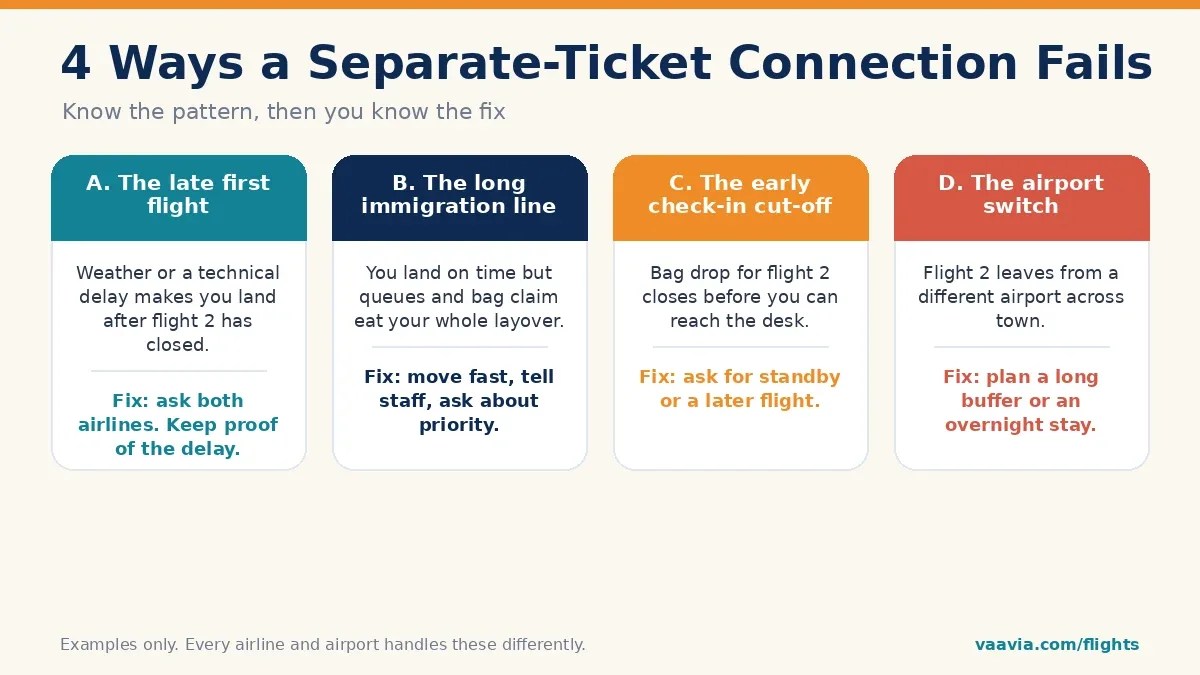
Four ways a separate-ticket connection fails: late first flight, long immigration line, early check-in cut-off, and airport switch
Scenario A: The Late First Flight
Weather, a technical problem, or air traffic control delays your first flight, and you land after the second flight has closed.
What to do: Contact both airlines right away. Ask the first airline for a written note about the delay, and ask the second airline about standby or a later flight. Keep screenshots of the delay notice. A documented delay can make an agent more willing to help, even though they are not required to.
Scenario B: The Long Immigration Line
Your first flight lands on time, but passport control, bag claim, and customs take far longer than you expected.
What to do: Tell airport staff that you have a tight connection, since some airports offer help for urgent connections. Contact the second airline by app or phone while you wait in line. If you cannot make it, ask about the next flight. In this case, you are closer to being late by your own timing than by the airline's delay, so expect less flexibility.
Scenario C: The Early Check-In Cut-Off
You reach the airport for your second flight before departure, but baggage drop has already closed.
What to do: Go to the desk immediately and ask whether there is any option for a late check-in, standby, or a later flight. Many airlines close check-in 45 to 60 minutes before departure, and some are strict about it. If you have only cabin baggage, you may have more options.
Scenario D: The Airport Switch
Your second flight leaves from a different airport, and the transfer takes longer than planned.
What to do: Contact the second airline as soon as you know you will be late. If the flight has not yet left, ask if they can hold your seat or put you on a later flight. If it has left, ask what the change or credit options are. In future, a long buffer or an overnight stay is the safest way to connect between airports.
A Simple Decision Guide
When panic sets in, a short checklist helps. Follow these questions from the top.
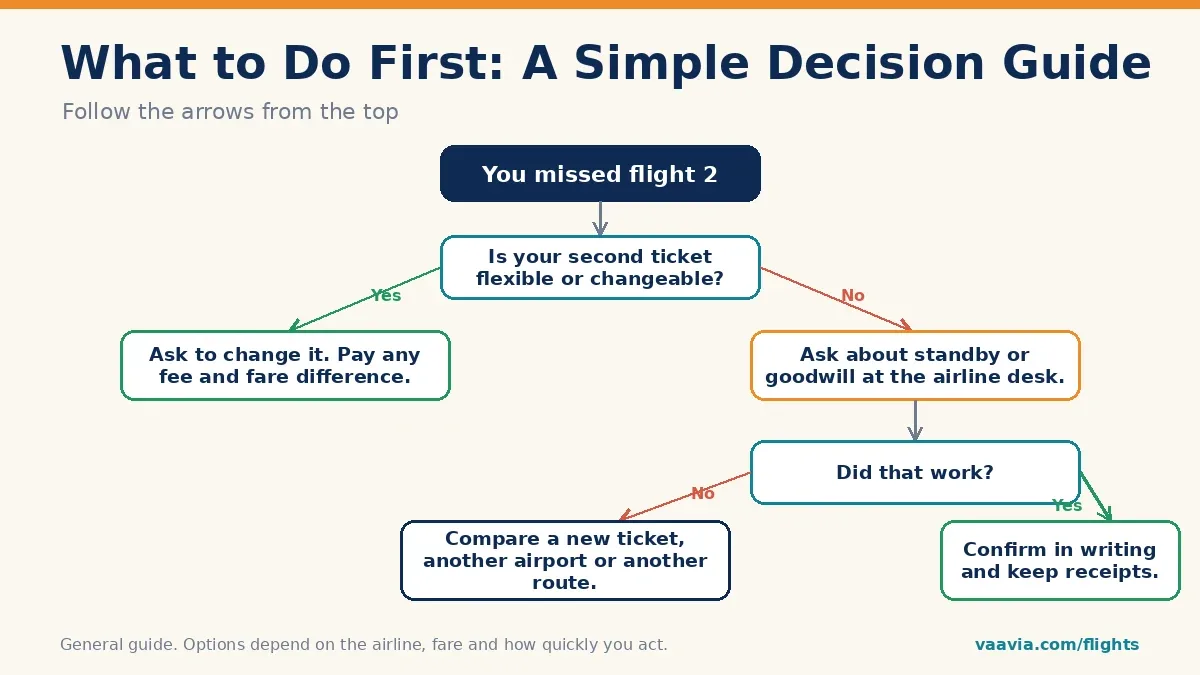
Decision guide showing what to do first after missing a connection on separate tickets
- Is your second ticket flexible or changeable? If yes, ask to change it. You may pay a fee and any difference in fare.
- If not, ask about standby or goodwill at the second airline's desk, app, or phone line.
- Did that work? If yes, confirm the new booking in writing and keep your receipts.
- If not, compare your alternatives: a new ticket, another airport, or a different route.
The most important thing is to ask before you buy. An agent may know about an option that is not shown online.
What to Say to the Airline Agent
Words matter. A calm, specific request is more likely to get a helpful response than a frustrated one.
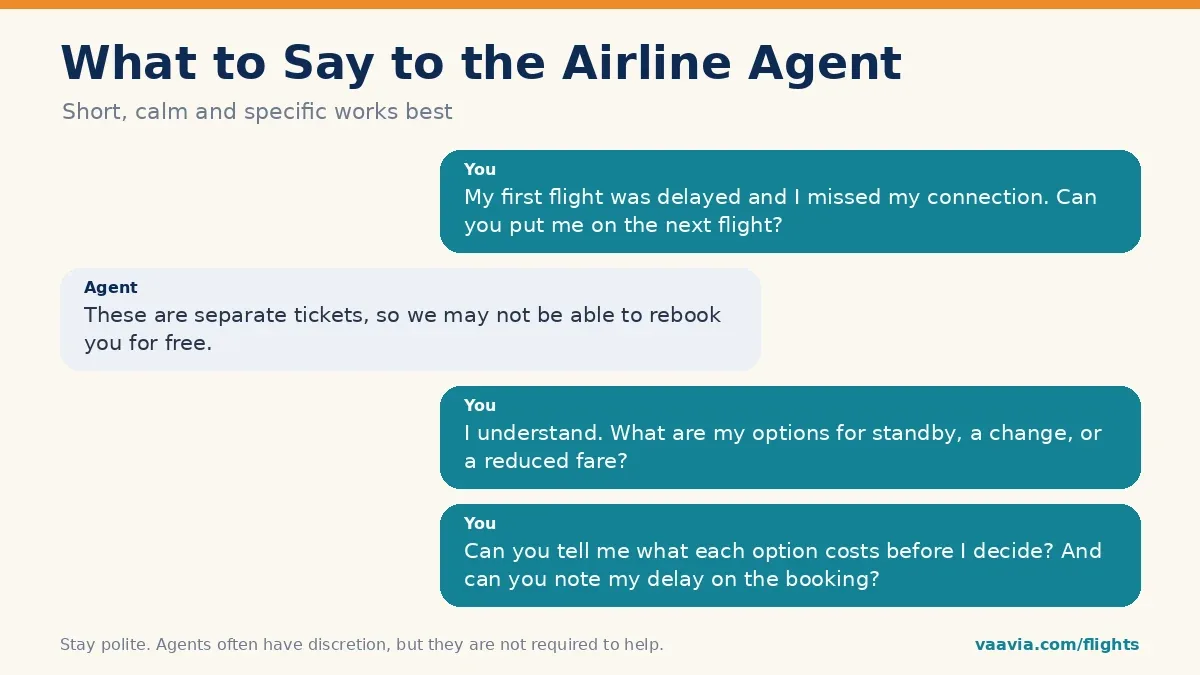
Sample conversation showing what to say to an airline agent after a missed connection
Here are some phrases that tend to work well:
- "My first flight was delayed, and I missed my connection. Can you put me on the next flight?"
- "I understand these are separate tickets. What are my options for standby, a change, or a reduced fare?"
- "Can you tell me what each option costs before I decide?"
- "Can you note the delay on my booking?"
- "Is there anything left of the value of my ticket, such as taxes, that I can get back?"
Stay polite, even if you are stressed. Agents often have some discretion, and a respectful tone makes it easier for them to help. If you are not getting anywhere on the phone, try the airport desk, the app chat, or a second call. For a quick refresher on reaching the right person, see our guide on what to do if you missed your flight.
What Will It Cost?
The cost depends on your ticket and your situation. As a general picture:
- Standby or goodwill: Often the lowest cost, but not guaranteed.
- Changing a flexible ticket: You may pay a change fee, if any, plus the difference in fare.
- Changing a restricted ticket: Basic fares may not allow changes at all.
- Buying a new ticket: Often the highest cost, particularly for same-day travel or busy routes.
- Extra costs: A hotel night, meals, airport transfers, and the cost of getting your baggage sorted out.
The real cost of a missed connection is often not just the ticket. It can include a hotel, a lost day, and missed plans at your destination. When you compare separate tickets with a single ticket, think about the worst case as well as the savings.
If You Need to Buy a New Ticket
Sometimes a new ticket is the only practical option. If so, you can take steps to reduce the cost.
- Compare more than one airline. Prices for the same route can differ a lot.
- Check nearby airports. A different departure or arrival airport can sometimes be cheaper.
- Consider a later flight. If you can wait a few hours or leave the next morning, the price may drop.
- Look at connecting options. A route with a stop can cost less than a direct flight.
- Ask about the old ticket. Ask the airline whether any of it can be refunded or credited.
Fares for last-minute travel are usually higher, but there are ways to find reasonable prices. Our guide to last-minute flights from the USA explains how to compare fares quickly and what to watch for before you pay.
If Your Second Ticket Was a One-Way
Many separate-ticket trips use one-way tickets, especially when different airlines are involved. One-way fares can be less flexible than round trips in some cases, so the rules for changes and refunds matter even more.
Before you book, check the fare conditions for each leg. Ask whether you can change the date or time, what happens if you miss the flight, and whether any part of the ticket is refundable. If you are not sure whether a one-way or a round trip makes more sense for your trip, our comparison of one-way vs round trip flights explains the differences in price and flexibility.
What Your First Airline Might Do
The first airline is responsible for its own flight, not for your second ticket. That said, there are things you can ask.
- Written confirmation of the delay: A note or screenshot showing the cause and length of the delay can support a claim or a request for help.
- Rebooking or a refund of the first flight: If the airline cancelled the flight or made a major change, you may be entitled to rebooking or a refund of that flight.
- Help with meals or hotels: Some airlines provide this for delays within their control, depending on their policies and the length of the delay.
- A goodwill gesture: Some airlines may offer a voucher or credit for a long delay.
Do not assume the first airline will pay for your second ticket. Many airlines do not, but it costs nothing to ask, and a documented delay can help if you later claim on insurance or a credit card.
Claims, Receipts, and Records
If you hope to recover any of your costs, good records are essential.
- Save every receipt: meals, hotels, transport, and any new tickets.
- Take screenshots: the delay notice, flight status pages, and your original bookings.
- Note names and times: write down who you spoke to and when.
- Keep baggage receipts and tags until your bags have arrived.
- Ask for written confirmation of any change, credit, or refund the airline offers.
- Check your insurance and card benefits. Some cover missed connections or trip delays, but many have conditions. Check the policy before you travel and file a claim as soon as you can.
A Simple Buffer Formula for Next Time
The best way to deal with a missed connection is to avoid one. A simple way to choose your layover is to add up the time each part of the connection takes.
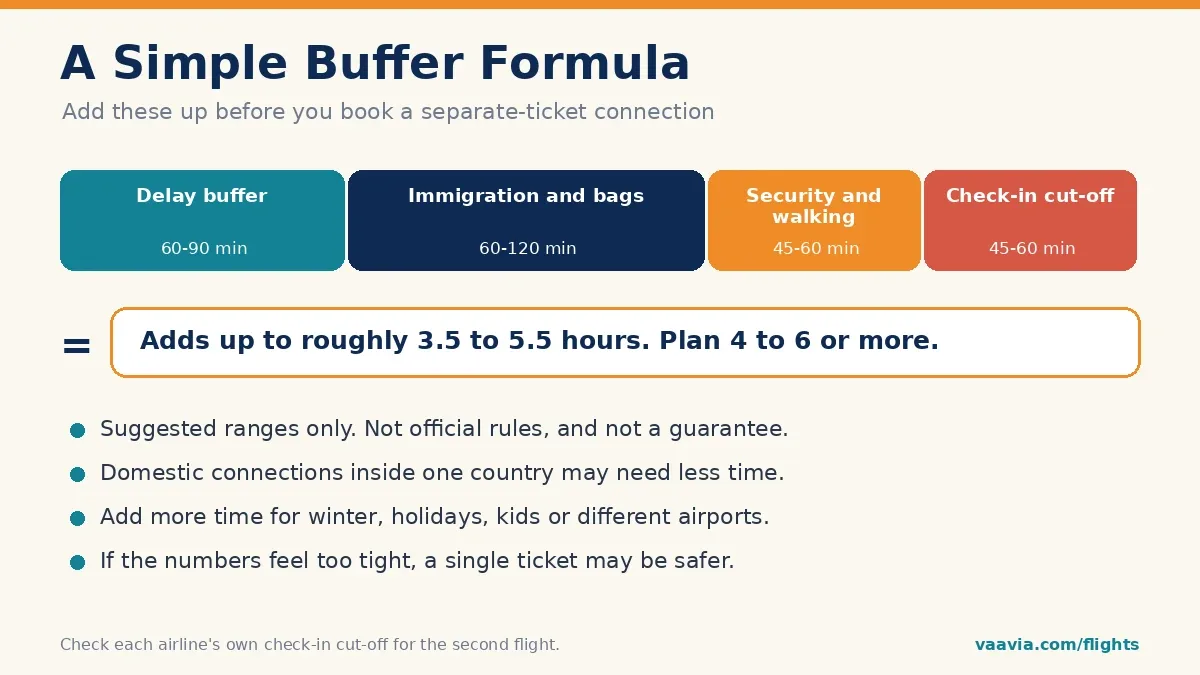
Buffer formula showing delay buffer, immigration and bags, security and walking, and check-in cut-off adding up to a suggested layover
- Delay buffer: about 60 to 90 minutes in case your first flight is late.
- Immigration and bags: about 60 to 120 minutes if you must enter a country and collect your bags.
- Security and walking: about 45 to 60 minutes to re-clear security and reach your gate.
- Check-in cut-off: about 45 to 60 minutes, because bag drop usually closes before boarding.
Adding these up gives roughly 3.5 to 5.5 hours, so many travelers plan 4 to 6 hours or more for an international self-transfer. These are suggested ranges only, not official rules. Domestic connections inside one country may need less time, and winter, holidays, children, or a change of airport may need more.
When One Ticket Is the Smarter Choice
Sometimes the cheapest option is not the best one. A single ticket may be a better choice when:
- The layover is short, and you cannot add a safe buffer.
- You have a fixed deadline, such as a wedding, a cruise departure, or an important meeting.
- You are traveling with children or anyone who needs extra time.
- The trip is expensive and non-refundable, so a miss would cost a lot.
- You are connecting at a busy hub in winter or at a peak travel time.
- The price difference is small, so the savings do not justify the risk.
If you are comparing different ways to build an itinerary, our guide to multi-city flight booking shows how to combine several flights on one ticket, which can keep the airline responsible for your connections.
Quick Checklist
If you miss a connecting flight on separate tickets, work through these steps:
- Confirm that your flight really left, and note why you were late.
- Contact the second airline immediately by desk, app, or phone.
- Ask about standby, a change, or a reduced fare before you buy anything.
- Ask what each option costs.
- Contact the first airline and ask for written delay confirmation.
- Check on your baggage.
- Keep every receipt, screenshot, and note for any claim.
Plan Your Trip With Vaavia
Separate tickets can save money when everything goes smoothly, but a missed connection can quickly erase those savings. Compare the total cost, leave a long buffer, and keep a clear plan for what to do if things go wrong.
Vaavia can help you compare flights, understand fare rules, and choose an itinerary that fits your plans and your comfort with risk. Browse current flights, or request a callback to talk through your options with a booking specialist.
Frequently Asked Questions
What happens if you miss a connecting flight on separate tickets?
The second airline usually treats you as a no-show and is not required to rebook you for free. You may be able to get standby, a change for a fee, or a reduced fare, or you may need to buy a new ticket.
Will the second airline help me if my first flight was late?
It may, but it is not required to. Agents often have some discretion, especially if you contact them quickly and can show proof of the delay.
Can I get a refund for the flight I missed?
It depends on your fare. Refundable tickets may return your money, while non-refundable tickets may give only taxes, a credit, or nothing. Ask the airline what remains.
What should I say to the airline agent?
Explain calmly what happened, ask about standby, a change, or a reduced fare, and ask for the cost of each option before you decide. Ask them to note the delay on your booking.
Is it better to buy a new ticket right away?
Not always. Ask about other options first, since a new ticket is often the most expensive choice. If nothing else works, compare several airlines and nearby airports.
Does travel insurance cover this?
Some policies cover missed connections, but many have conditions or exclusions for separate tickets. Read the policy and ask your insurer before you travel.
How long a layover do I need on separate tickets?
Many travelers plan about 4 to 6 hours or more for international connections, and sometimes an overnight stay. These are suggestions, not rules, and you should add time for winter, holidays, children, or an airport change.
When should I choose a single ticket instead?
When the layover is short, the deadline is fixed, you are traveling with children, or the price difference is small. A single ticket keeps the airline responsible for your connection.