





How Long Should a Layover Be for a Domestic or International Flight?
Updated for 2026-2027 travel. Baggage handling and entry procedures vary by airline, airport, and country, so confirm the details with your airline before you travel. Suitcases on a conveyor belt with a luggage tag and text Recheck Baggage on Connecting International Flights, What to know before you land

Last updated Oct 25, 2026
A good layover is long enough to make your next flight without rushing and short enough that you are not stuck at the airport for hours. So, how long should a layover be? For most domestic connections, 1 to 2 hours is a comfortable range. For international connections, 2 to 3 hours can work if you stay in the transit area, and 3 to 4 hours or more is safer if you must clear immigration, customs, or recheck bags. The right answer depends on your ticket, your route, and your baggage. This guide explains how to choose a layover length, what changes between domestic and international trips, and what to do if things go wrong. If you are still planning your route, start with our international flight booking guide so you understand the basics before you buy.
On This Page
- How Long Should a Layover Be?
- Layover vs Minimum Connection Time
- Domestic Layovers: How Much Time Do You Need?
- International Layovers: How Much Time Do You Need?
- Single Ticket vs Separate Tickets
- Baggage and Layover Length
- Layovers That Are Too Short or Too Long
- Suggested Layover Times at a Glance
- What If You Miss Your Connection?
- Tips Before You Book
- Common Mistakes to Avoid
- Quick Checklist
- Plan Your Trip With Vaavia
- Frequently Asked Questions
How Long Should a Layover Be?
There is no single number that works for every trip. The right layover length depends on five things:
- Domestic or international: International connections usually involve more steps, such as passport control, customs, and sometimes a new security check.
- One ticket or separate tickets: On a single ticket, the airline helps you if you miss the connection. On separate tickets, the risk is yours.
- Checked bags or cabin bag only: Checked bags may need to be collected and dropped off again, which adds time.
- Airport size and layout: Large hubs can mean long walks, train rides between terminals, and long security lines.
- Time of day and season: Peak hours, holidays, and bad weather can slow every step.
A simple rule helps: the more steps between your arrival gate and your next departure gate, the more time you should allow. A short walk to the next gate needs far less time than clearing immigration, collecting a bag, and passing security again.
Layover vs Minimum Connection Time
These two terms are related, but they are not the same.
Layover is the actual time between your flight landing and your next flight departing. This is the number you see on your itinerary, for example 2 hours 15 minutes.
Minimum connection time (MCT) is the shortest time an airport or airline allows for a connection to be booked. It is set for each airport, and it is often longer for international or terminal-change connections. If a booking system lets you buy a connection, your layover meets the minimum.
The key point: a connection that meets the minimum is possible, but it is not always comfortable. Minimum connection times assume that your first flight arrives on time and that you move through the airport without delay. If you want a margin for lines, late arrivals, or a long walk, plan for more than the minimum.
Domestic Layovers: How Much Time Do You Need?
For most domestic connections on a single ticket, a layover of 1 to 2 hours is a comfortable range. Here is how to think about it:
- Under 1 hour: Possible at small airports with one terminal, but risky. A short delay on your first flight can cost you the connection.
- 1 to 2 hours: A good balance for most travelers. You have time to walk to the next gate, use the restroom, and board without rushing.
- 2 to 3 hours: A safer choice at large hubs, during busy seasons, or when you must change terminals or collect and recheck bags.
- 3 hours or more: Useful if you want a meal, a rest, or extra protection against delays, but it can make a trip long.
A few things can add time even on a domestic trip: a terminal change that needs a shuttle or train, a late-arriving first flight, winter weather, and a connection through a very large airport. If your first flight often runs late, choose a longer layover.
On a domestic route within a single country, you usually do not need to clear immigration, so the main steps are walking to the next gate and, in some cases, passing security again.
International Layovers: How Much Time Do You Need?
International connections need more time than domestic ones, because there are often more steps between your two flights. As a general guide, plan for 2 to 3 hours if you stay in the transit area, and 3 to 4 hours or more if you must enter the country and recheck bags.
Steps that can add time on an international layover:
- Immigration and passport control: Lines can be short or very long, depending on the airport and the time of day.
- Customs: If you must collect your bags and clear customs, add time for waiting at the belt and for the customs queue.
- Baggage recheck: After customs, you may need to drop bags at a transfer desk before your next flight. Read our guide on whether you need to recheck baggage on connecting international flights for details.
- Security re-screening: Some airports require a second security check for connecting passengers.
- Terminal changes: Moving between terminals can take 20 minutes or more, and some airports need a train or bus.
- Visa and transit rules: Some nationalities need a transit visa even for a short stop. Check the rules for every country you pass through.
For long international trips, a layover of 3 to 4 hours is a common comfortable choice. Layovers over 6 hours may let you rest, eat, or use an airport lounge. Layovers over 8 hours may be long enough for a short city visit in some cases, but only if your visa rules, baggage handling, and the return time to the airport all allow it.
Single Ticket vs Separate Tickets
How you book changes how much layover time is safe.
Single ticket (one booking): The airlines treat your trip as one journey. If your first flight is late and you miss the connection, the airline usually rebooks you at no extra cost and handles your bags. This protection lets you choose a shorter layover with more confidence.
Separate tickets (different bookings): The airlines treat each flight as an unrelated trip. If the first flight is late, the second airline may not help you, and you may have to buy a new ticket. Bags are also rarely transferred between separate bookings, so you usually collect and recheck them.
Because of this extra risk, travelers on separate tickets usually plan a much longer layover:
- Domestic, separate tickets: About 3 to 4 hours or more.
- International, separate tickets: About 4 to 6 hours or more, or an overnight stay.
If you want to compare how single and multi-ticket trips work, our guide on how to choose and book flights from the USA explains the differences.
Baggage and Layover Length
Your bags can change how long a layover should be.
- Cabin bag only: You do not need to collect or recheck anything, so you can often use a shorter layover.
- Checked bags, checked through: If your bags are tagged to your final airport, you do not collect them at the connecting airport. The airline moves them between planes, and your layover mainly depends on gates and security.
- Checked bags, recheck required: If you must collect your bags, clear customs, and drop them off again, plan for a longer layover. Some airlines also set a cut-off time for bag drop before departure.
Before you fly, ask at check-in whether your bags are checked through to your final destination, and read the three-letter airport code on the bag tag. If your trip includes a change of airline or a separate ticket, confirm this again.
Fare type can also affect your bags. Some low-fare tickets include no checked bag or charge for a larger cabin bag. Our guide to basic economy vs main cabin explains how fare type can change your baggage options.
Layovers That Are Too Short or Too Long
Risks of a Layover That Is Too Short
- You may miss your connection if the first flight is late.
- You may not have time to clear immigration, collect bags, or pass security.
- A terminal change or a long walk can use up your whole layover.
- On separate tickets, you may need to buy a new ticket.
Risks of a Layover That Is Too Long
- You spend hours at the airport, which can be tiring on a long trip.
- Meals, lounge access, or a hotel can add cost.
- A very long layover can make your total travel time much longer.
- If you leave the airport, you need to allow time for visa rules, traffic, and returning for security.
Layover vs Stopover
A layover is usually a short connection, often under 24 hours. A stopover is a longer stay at a connecting city, and some airlines allow it on certain international tickets. If you want to see a city on your way, ask the airline or your booking specialist whether a stopover is available on your route.
Suggested Layover Times at a Glance
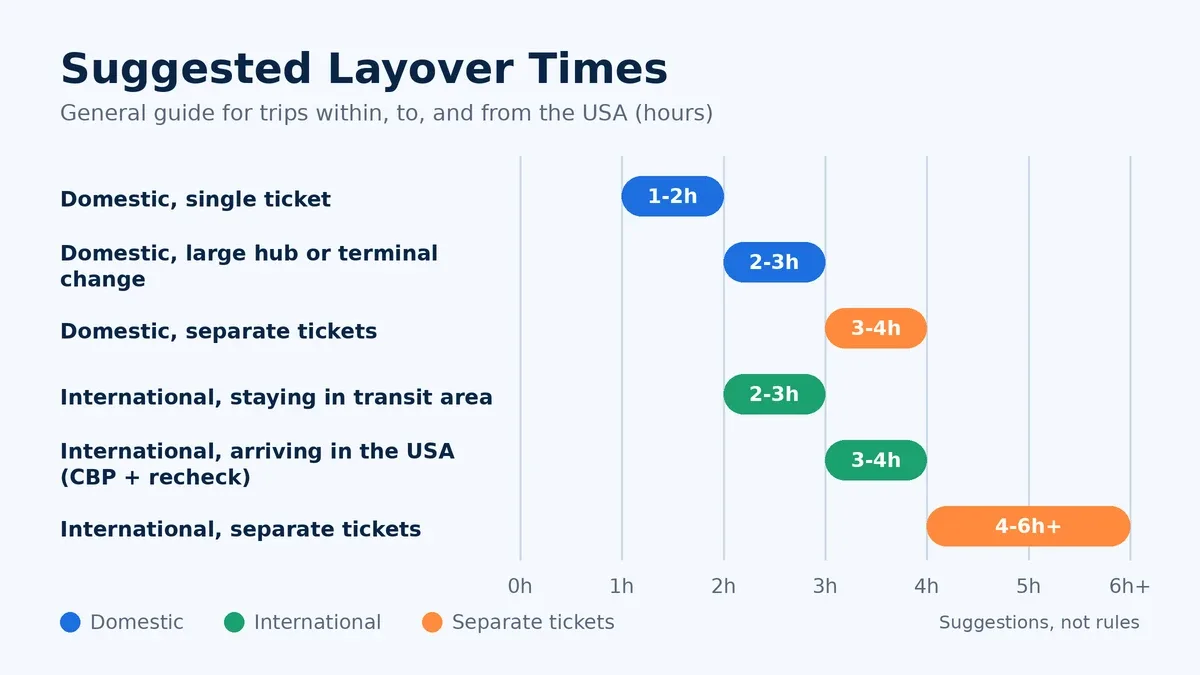
These are general suggestions, not rules. Busy airports, long lines, and bad weather can make any connection slower.
Situation | Suggested layover |
|---|---|
Domestic, single ticket, cabin bag only | 1 to 2 hours |
Domestic, single ticket, bags checked through | 1.5 to 2 hours |
Domestic, terminal change or large hub | 2 to 3 hours |
Domestic, separate tickets | 3 to 4 hours or more |
International, single ticket, staying in transit area | 2 to 3 hours |
International, entering a country, bags to recheck | 3 to 4 hours or more |
International, separate tickets | 4 to 6 hours or more, or overnight |
Long layover with a city visit | 8 hours or more, subject to visa rules |
What If You Miss Your Connection?
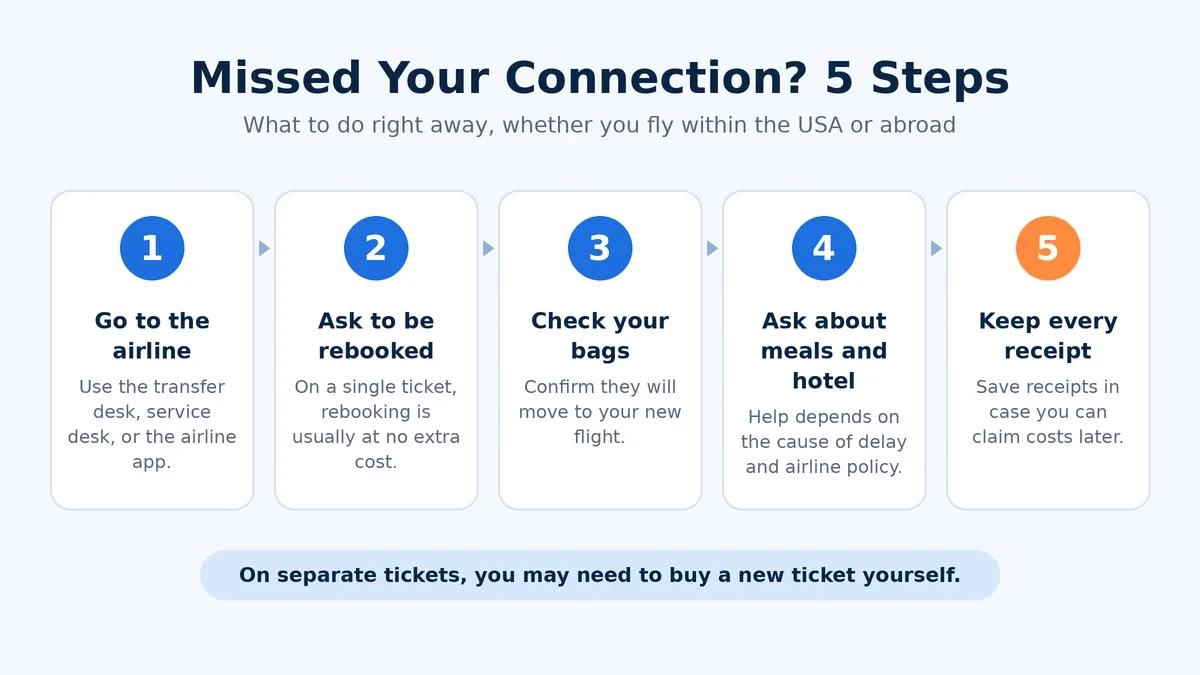
Even with good planning, delays happen. If you miss your connecting flight, stay calm and act quickly.
- Go to the airline right away. Use the transfer desk, the customer service desk, or the airline app. Do not wait until the line is long.
- Ask about rebooking. On a single ticket, the airline usually rebooks you on the next available flight at no extra cost.
- Ask about your bags. Confirm that your checked bags will be moved to your new flight.
- Ask about meals and a hotel. If the delay is long, some airlines offer help, depending on the cause and their policy.
- Keep your receipts. Save receipts for meals, hotels, and other costs in case you can claim them later.
On separate tickets, the second airline may not have to help you. You may need to buy a new ticket yourself, and a travel insurance policy that covers missed connections may help. This is one more reason to choose a longer layover when your flights are on different bookings.
Tips Before You Book
- Prefer a single ticket. It gives you protection if your first flight is late.
- Check the minimum connection time. Then add a buffer, especially at large airports.
- Look at the airport and terminal. A connection that needs a terminal change takes longer.
- Check the first flight's on-time record. A flight that often runs late needs a longer layover.
- Avoid the last flight of the day. If you miss it, you may wait until the next day.
- Choose a longer layover in winter or peak season. Weather and crowds slow everything down.
- Check visa and transit rules for every country you pass through.
- Keep essentials in your cabin bag. Carry medicine, documents, chargers, and a change of clothes.
- Compare fares carefully. A cheaper fare with a very short layover may not be better value. Our flight fare and ticket guide explains what each fare includes.
Common Mistakes to Avoid
- Booking the shortest possible layover. Meeting the minimum connection time does not leave room for delays.
- Forgetting about immigration and customs. On international trips, lines can take much longer than expected.
- Ignoring terminal changes. A change of terminal can use a large part of a short layover.
- Booking separate tickets with a short buffer. If your first flight is late, there is little protection.
- Assuming bags are checked through. Always confirm at check-in.
- Packing essentials in checked bags. Keep medicine, documents, and valuables with you.
- Skipping visa and transit checks. Some travelers need a transit visa even for a short stop.
- Choosing the last flight of the day. A missed connection can turn into an overnight wait.
- Not saving receipts. You may need them for a delayed bag or a claim.
Quick Checklist
Before you book or connect, ask yourself:
- Is my trip on one ticket or separate tickets?
- Is this a domestic or an international connection?
- Do I need to clear immigration or customs at the connecting airport?
- Are my bags checked through, or do I need to recheck them?
- Do I need to change terminals or airports?
- Is my layover longer than the minimum connection time, with a buffer?
- Do I have my essentials, documents, and chargers in my cabin bag?
- Do I know who to contact if I miss my connection?
If you can answer yes to all eight, you are ready to connect with confidence.
Plan Your Trip With Vaavia
The best layover is one that gives you time to connect comfortably without wasting hours at the airport. Confirm your ticket type, check the airport and terminal details, and add a buffer for delays and baggage.
Vaavia can help you compare flights, understand fare and baggage rules, and choose a route with a layover that fits your plans. Browse current international flights, or request a callback to talk through your itinerary with a booking specialist.
Frequently Asked Questions
How long should a layover be for a domestic flight?
For most domestic connections on a single ticket, 1 to 2 hours is a comfortable range. Choose 2 to 3 hours at a large hub, during busy seasons, or if you must change terminals or recheck bags.
How long should a layover be for an international flight?
Plan about 2 to 3 hours if you stay in the transit area, and 3 to 4 hours or more if you must clear immigration, customs, or recheck bags.
What is the minimum layover time?
The minimum is the shortest connection an airport or airline allows to be booked. It differs by airport and by domestic or international travel. A connection that meets the minimum is possible, but a buffer is safer.
Is a 1-hour layover enough?
Sometimes, for a domestic connection at a small airport with a short walk and no bags to recheck. It is risky for international connections, and it leaves little room for delays.
Is a 2-hour layover enough for an international flight?
It may be enough if you stay in the transit area and your bags are checked through. If you must clear immigration or recheck bags, it is often too short.
How long should a layover be on separate tickets?
Longer than on a single ticket. A common suggestion is 3 to 4 hours or more for domestic trips, and 4 to 6 hours or more for international trips.
Can a layover be too long?
Yes. Very long layovers can make a trip tiring and add cost for meals or a hotel. Choose a long layover only if you want the extra time, for example to rest or visit a city.
What should I do if I miss my connecting flight?
Go to the airline right away. On a single ticket, they can usually rebook you and move your bags. On separate tickets, you may need to buy a new ticket yourself.
Do I need a visa for a layover?
It depends on your nationality, the country you connect in, and whether you leave the transit area. Check the entry and transit rules for every country on your route before you book.
How long should a layover be when I connect through a US airport from another country?
Plan for 3 to 4 hours or more. You usually must clear CBP passport control and customs at your first US airport, collect and recheck your bags, and pass security again, so a short layover is risky.
Do I need ESTA or a visa to connect through the USA?
Usually yes. Most visitors need an approved ESTA or a US visa, even when they only connect. Check the rules for your nationality before you book.