



Basic Economy vs Main Cabin: What You Give Up and When It Pays Off
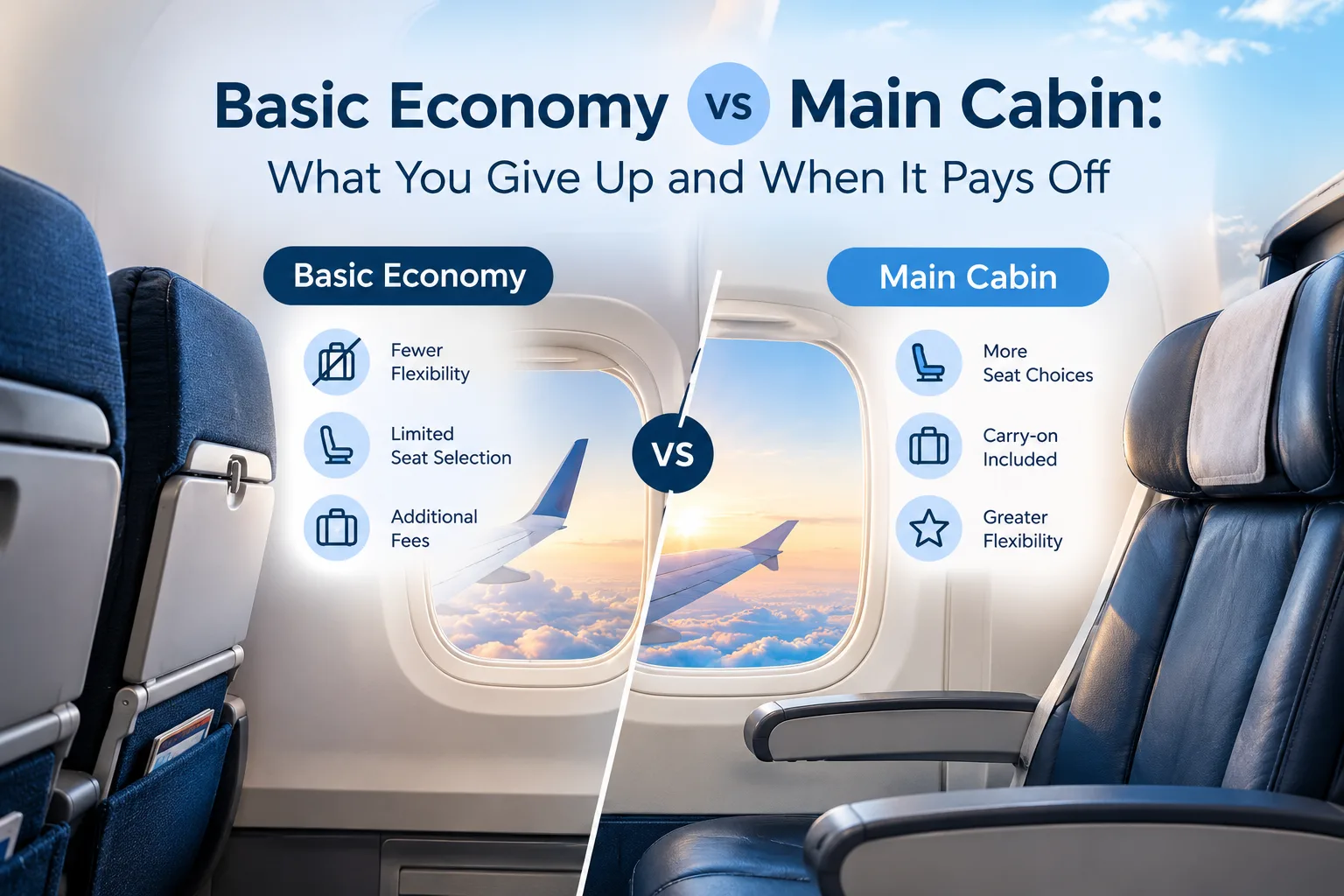
In the basic economy vs main cabin choice, both fares usually seat you in the same economy cabin; the rules are what differ. Basic economy usually gives up seat choice, changes, upgrades and an early boarding group, and on some airlines a full-size carry-on. Main cabin usually keeps those options open. Rules vary by airline.
Last updated Oct 11, 2026
What is the difference between basic economy and main cabin?
Basic economy and main cabin are usually two prices for the same economy seats, and what separates them is what each fare lets you do before and after you buy. On the Vaavia flight search both can appear for one flight, and the gap between them pays for flexibility rather than for a better seat.
Basic economy: Basic economy is an airline's entry-level economy fare, sold with fewer included services and tighter seating and change rules than the standard economy fare on the same flight.
Main cabin: Main cabin is a name many airlines give their standard economy fare, which usually allows seat selection, changes under the fare rules and an ordinary boarding group.
Labels differ between airlines, and not every airline sells a restricted entry-level fare. Read the rules attached to the fare rather than its name.
What does basic economy usually restrict compared with main cabin?
Basic economy usually restricts seat choice, changes, upgrades, boarding order and loyalty earning, and on some airlines the carry-on bag, all of which a main-cabin fare normally allows in some form.
- Seats: on many airlines the seat is assigned for you, often only at check-in, and paying to choose one may not be offered.
- Changes: often not permitted once ticketed, though some airlines allow one for a fee plus any difference in fare.
- Bags: a full-size carry-on sits inside the fare on some airlines and outside it on others; the personal item is included everywhere.
- Boarding and upgrades: usually a late boarding group and no upgrade eligibility, paid or otherwise.
- Loyalty: reduced miles or no status credit on many programs, so check your airline's program rules.
Every one of those points is airline-specific. Two restricted fares on two airlines can behave quite differently, so the fare rules on the booking page are the only reliable source.
Our domestic flights page covers the identification and bag points that apply to U.S. trips whichever fare you pick.
Can you change or cancel a basic economy ticket?
On many airlines a basic economy ticket cannot be changed once it is issued and returns little or nothing if canceled, although some airlines allow a change for a fee plus any difference in fare.
Main cabin is the usual step up when plans might move: still non-refundable on most airlines, but often changeable under the fare rules. For a ticket that already has to move, see flight changes and rebooking.
Some protections do not depend on the fare at all. The U.S. Department of Transportation's airline ticket refunds guidance says a traveler is entitled to a refund when the airline cancels the flight, for any reason, or changes it significantly, and the traveler does not accept the alternative offered. It is equally clear about the reverse case: a non-refundable ticket is not refunded when the traveler decides not to fly and the flight operates as scheduled.
The 24-hour rule is narrower than many people assume. Under the federal customer service rule at 14 CFR 259.5, an airline must either hold a reservation at the quoted fare or allow a penalty-free cancellation for twenty-four hours, when the booking is made a week or more before departure. The Department says that requirement does not reach tickets bought through travel agencies.
On a Vaavia booking, contact Vaavia within 24 hours of booking and at least seven days before departure, and Vaavia will try to cancel with the airline at no charge from Vaavia. The airline has the final say on whether a restricted fare can be canceled, and the agency service fee shown before payment is not returned.
Will a family sit together on a basic economy fare?
A family is not reliably seated together on basic economy, because many airlines assign those seats themselves, often at check-in, unless that airline has made a family seating commitment.
The Department of Transportation's airline customer service dashboard shows which airlines commit to seating a young child next to an accompanying adult at no additional cost, and the Department holds airlines to the commitments listed there. Not every airline makes that promise, so look yours up before buying a restricted fare for children. If a commitment is not kept, contact the airline first, then the Department.
A commitment of that kind covers a child and one accompanying adult, not a whole party, so adults who want to sit together usually do better with main cabin and seats chosen at booking. Family flight booking covers what else to plan when children fly.
How do you decide which fare to buy for your trip?
Decide by pricing the restricted fare with its missing pieces added back, then asking honestly how likely the trip is to move. Do it before you pay, because switching fares after ticketing may not be possible.
- Open both sets of fare rules. Note what each fare says about seats, changes, canceling, bags and boarding group, on the same flight and the same date.
- Add the extras back. Count the seat and bag charges you would pay on the restricted fare, taken from the airline's own policy page, before comparing the two.
- Weigh the chance of a change. If the date could realistically move, set that against a fare that may allow no change at all once it is issued.
- Check the family seating position. Traveling with children, look your airline up on the Department of Transportation dashboard before you choose the restricted fare.
- Ask a consultant before you pay. A Vaavia travel consultant can read both sets of fare rules to you, and can quote some fare types an online search does not show.
Which fare allows what, feature by feature?
Side by side, the two fares differ on a handful of points, and almost every one varies by airline. Use the table as a checklist of questions to put to the fare rules.
| Feature | Basic economy (usually) | Main cabin (usually) |
|---|---|---|
| Seat selection | Assigned by the airline, often at check-in | Chosen at booking; some seats cost extra |
| Changes after ticketing | Often not allowed; varies by airline | Allowed under the fare rules, often for a fee |
| Canceling | Usually little back beyond refundable taxes | Often an airline credit; varies by airline |
| Upgrades | Usually not eligible | Often eligible, paid or with miles |
| Boarding group | Usually one of the last | A standard group |
| Full-size carry-on | Included on some airlines, not others | Usually included with a personal item |
| Miles and status credit | Reduced or none; varies by airline | Usually earned for the fare paid |
The table shows common patterns, not any one airline's policy. Check the fare rules for the exact fare you are about to buy.
What do people get wrong about basic economy vs main cabin?
The commonest mistake is comparing the two fares on their headline figures alone. What separates them is a set of rules, and those rules cost money only when the trip needs something the fare removed.
- Assuming the restrictions are the same everywhere. They are set airline by airline, and the carry-on is where they differ most.
- Forgetting the extras. A paid seat and a bag can bring the restricted fare close to the one that included both.
- Buying it for a trip that may move. A fare allowing no change can end up being bought twice.
- Expecting children beside you. That depends on the airline's seating commitment, not on the fare you paid.
- Reading the 24-hour rule as universal. It is written on airlines rather than agencies, and needs a booking made a week ahead.
- Treating a late boarding group as cosmetic. It is why overhead space runs out and a carry-on gets checked at the gate.
The cost of a wrong guess is lopsided. Choosing the flexible fare and never using its flexibility costs the difference in fare; needing a change on a fare that allows none can cost the whole ticket.
Where should you go next to choose between these fares?
Go to whichever page matches your trip: the fare levels inside a search, if you are still comparing prices, or a fare written to be canceled, if the dates are not settled.
- Cheap flights — how fare levels appear within one search, and which extras a low fare leaves out.
- Refundable flights — fares built to be canceled, for a trip whose dates may still move.
A Vaavia travel consultant can go through both fares on the flight you want before anything is paid, which is the only moment when the choice is still free to make.
Sources
- U.S. Department of Transportation — airline ticket refunds
- U.S. Department of Transportation — airline customer service dashboard
- 14 CFR 259.5 — customer service plans
Frequently Asked Questions
Is main cabin a better seat than basic economy?
Usually not. On most airlines the two fares use the same economy seats; what differs is whether you can choose the seat, change the ticket, board earlier or bring a full-size carry-on. Extra-legroom seats, where an airline offers them, are normally sold separately. Check the seat map and fare rules to be sure.
Can I pay to choose a seat on basic economy?
On some airlines, yes; on others the seat is assigned by the airline and cannot be chosen in advance. If you do pay the airline for a seat and the flight is canceled, the Department of Transportation says optional-service fees of that kind are refunded by the airline rather than by an agency.
Do I earn miles on a basic economy ticket?
It depends on the airline. Many programs earn reduced miles or no status credit on the restricted fare, and some give nothing at all, while main cabin usually earns for the fare paid. If loyalty status matters to you, read your airline's program rules for the exact fare before choosing.
Does the 24-hour cancellation rule cover basic economy?
The federal rule at 14 CFR 259.5 applies to reservations made with an airline a week or more before departure: the airline must offer a 24-hour hold or a penalty-free cancellation, whatever the fare. It does not reach travel agency bookings. Vaavia's own 24-hour practice stands in its place, and the airline still decides.
Can I upgrade a basic economy ticket to main cabin later?
Some airlines let you move up after booking, and others do not once the ticket is issued. Because the rule varies, deciding at the time of booking is the simplest way to secure main cabin's options. Ask a Vaavia consultant to check both sets of fare rules before you pay.
Do all airlines sell a basic economy fare?
No. Some airlines sell no restricted entry-level fare at all, others give theirs a different name, and a few apply it only on certain routes. Because the label carries no fixed meaning, compare what the rules permit on the flight in front of you rather than what the fare is called.