




What Is an Open Jaw Flight? Examples, Benefits, and Booking Tips
Updated for 2026-2027 travel. Airline rules, fares, and booking tools change often, so confirm the details with your airline before you book.
Last updated Oct 22, 2026
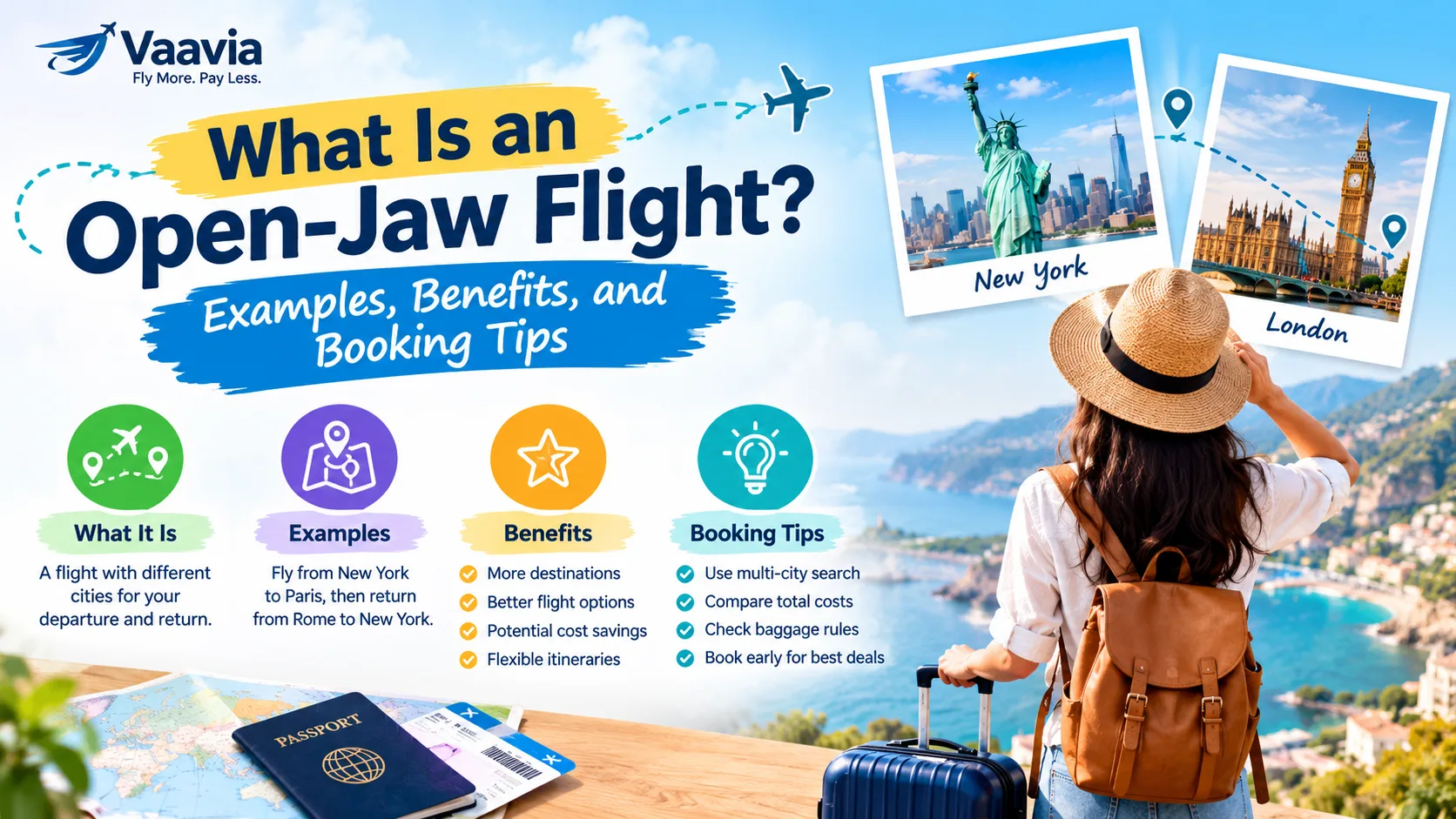
What is an open jaw flight? It is a ticket where you land in one city and fly home from another. Most trips start and end in the same city: you fly to your destination, then fly back the same way. But if you want to land in one city, travel overland, and head home from a different one, an open jaw ticket lets you do exactly that. This guide explains how it works, shows real-world examples, and covers the benefits and booking tips that matter. When you are ready to build your own route, you can use a multi-city flights search and enter each leg separately.
If you are still planning the basics, our guide to how to choose and book flights from the USA covers fares, timing, and what to compare before you pay.
By the end of this article, you will understand the different types of open-jaw tickets, when they make sense, and how to avoid the most common mistakes.
On This Page
- What Is an Open-Jaw Flight?
- Why Is It Called an Open-Jaw?
- 3 Types of Open-Jaw Flights
- Open-Jaw Flight Examples
- Open-Jaw vs Round Trip vs Multi-City
- Benefits of an Open-Jaw Flight
- Drawbacks to Consider
- Are Open-Jaw Flights More Expensive?
- Who Should Book an Open-Jaw Flight?
- How to Book an Open-Jaw Flight, Step by Step
- Open-Jaw Flight Booking Tips
- Changes, Cancellations, and Refunds
- International Open-Jaw Trips
- Common Mistakes to Avoid
- Quick Checklist
- Plan Your Trip With Vaavia
- Frequently Asked Questions
What Is an Open-Jaw Flight?
An open-jaw flight is a round-trip style ticket where the outbound and return flights do not connect the same pair of cities. Instead of flying A to B and back from B to A, you might fly A to B and return from C to A. The "gap" between where you landed and where you departed is not covered by your flight ticket. You travel that part yourself, by train, car, bus, or even another flight booked separately.
In everyday travel language, an open jaw is simply a trip where you arrive in one place and leave from another. It is often sold as one ticket, so airlines can still treat it like a round trip for pricing and rules.
Why Is It Called an Open-Jaw?
The name comes from how the route looks when you draw it on a map. A normal round trip makes a closed shape, like a mouth shut tight. An open-jaw route has a gap between two of the points, like a mouth that is open. That gap is the section you travel on your own.
3 Types of Open-Jaw Flights
There are three common ways to build an open-jaw itinerary.
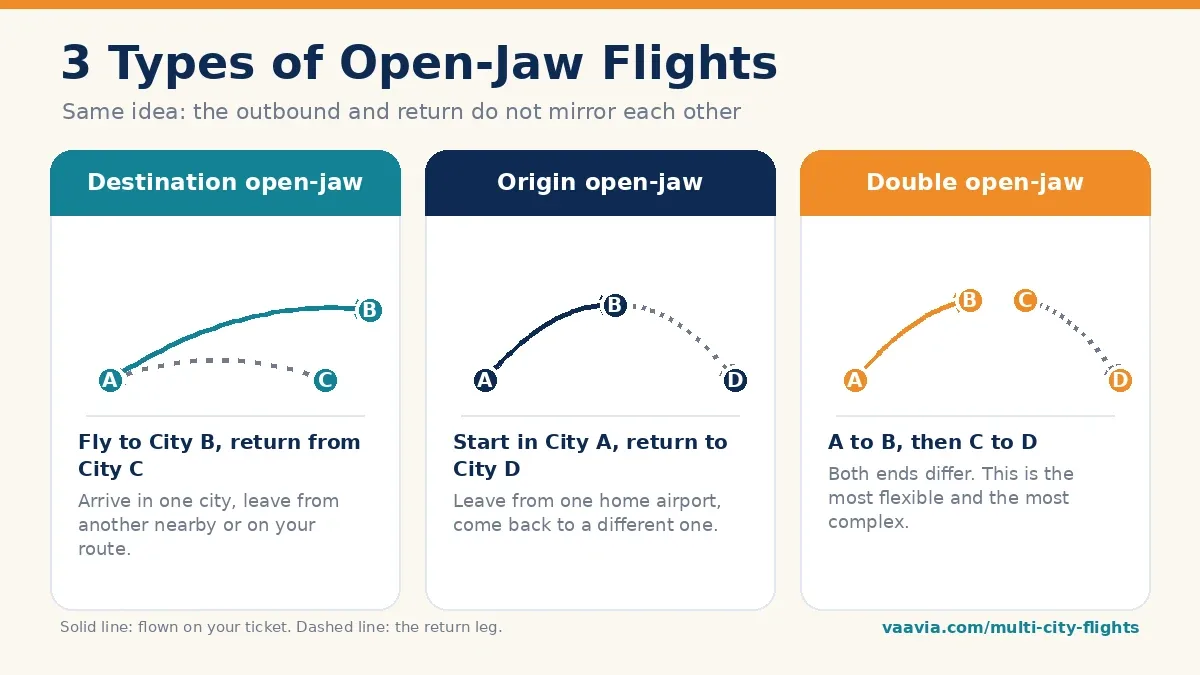
Destination Open-Jaw
You fly from your home city to one destination, then return from a different city. For example, you fly into one city, travel by rail or road to a second city, and fly home from there.
Origin Open-Jaw
You start in one city but return to a different one. This is useful if you live near two airports or if you are moving or changing your home base partway through the trip.
Double Open-Jaw
Both ends are different. You fly from City A to City B, then return from City C to City D. This is the most flexible type but also the most complex to price and plan.
Open-Jaw Flight Examples
Examples help make this clearer. These are illustrations of how the routes can look, not specific fares or schedules.
- Road trip along a coast: Fly into a city at the start of the coast, drive or take a train to a city at the other end, and fly home from there. You avoid driving all the way back to where you started.
- Two-country holiday: Fly into one country, travel overland to a neighboring country, and fly home from the second. You see more without repeating the same route.
- Work and vacation combined: Fly to a city for a conference, then continue to a second city for leisure and fly home from there.
- Moving or relocating: Start your trip from one home airport and return to another city where you now live.
- Family visits: Visit relatives in one city, then another, and return from the city closest to the last visit.
Open-Jaw vs Round Trip vs Multi-City
People often confuse these three ticket types. Here is how they differ.
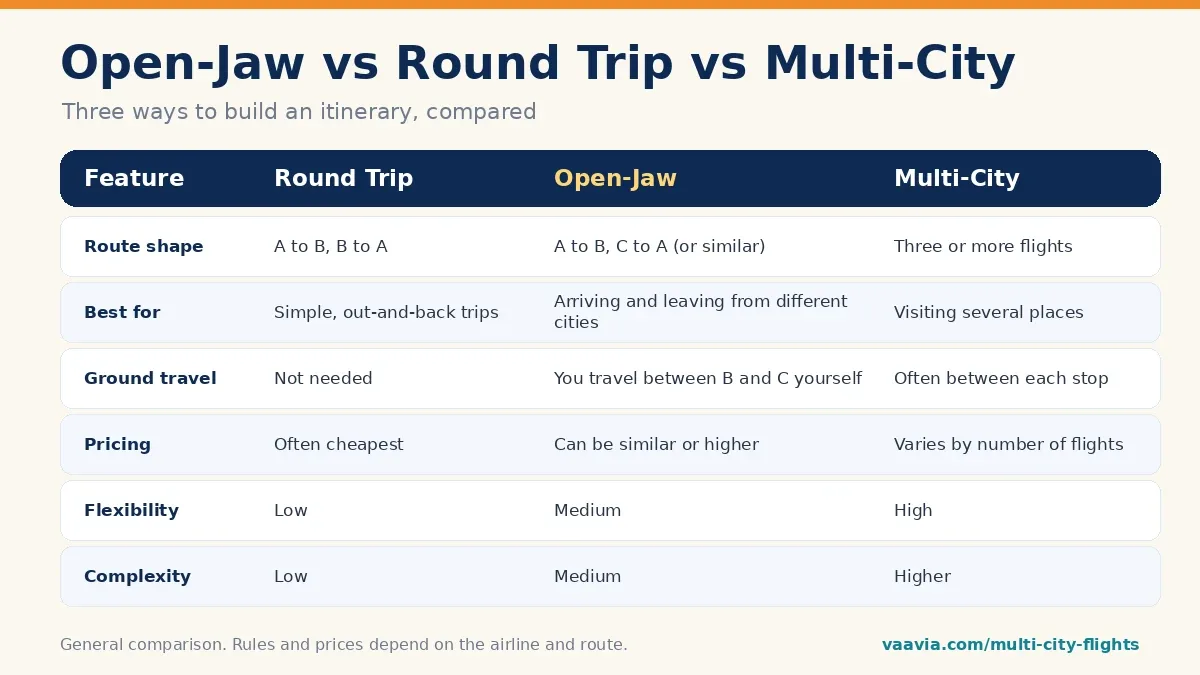
| Feature | Round Trip | Open-Jaw | Multi-City |
|---|---|---|---|
| Route shape | A to B, B to A | A to B, C to A (or similar) | Three or more flights |
| Best for | Simple out-and-back trips | Arriving and leaving from different cities | Visiting several places |
| Ground travel | Not needed | You travel between B and C yourself | Often between each stop |
| Pricing | Often cheapest | Can be similar or higher | Varies by number of flights |
| Flexibility | Low | Medium | High |
| Complexity | Low | Medium | Higher |
An open-jaw can be thought of as a special type of multi-city trip with just two flights, where the cities do not match up. Many booking tools handle open-jaw trips through their multi-city search.
Benefits of an Open-Jaw Flight
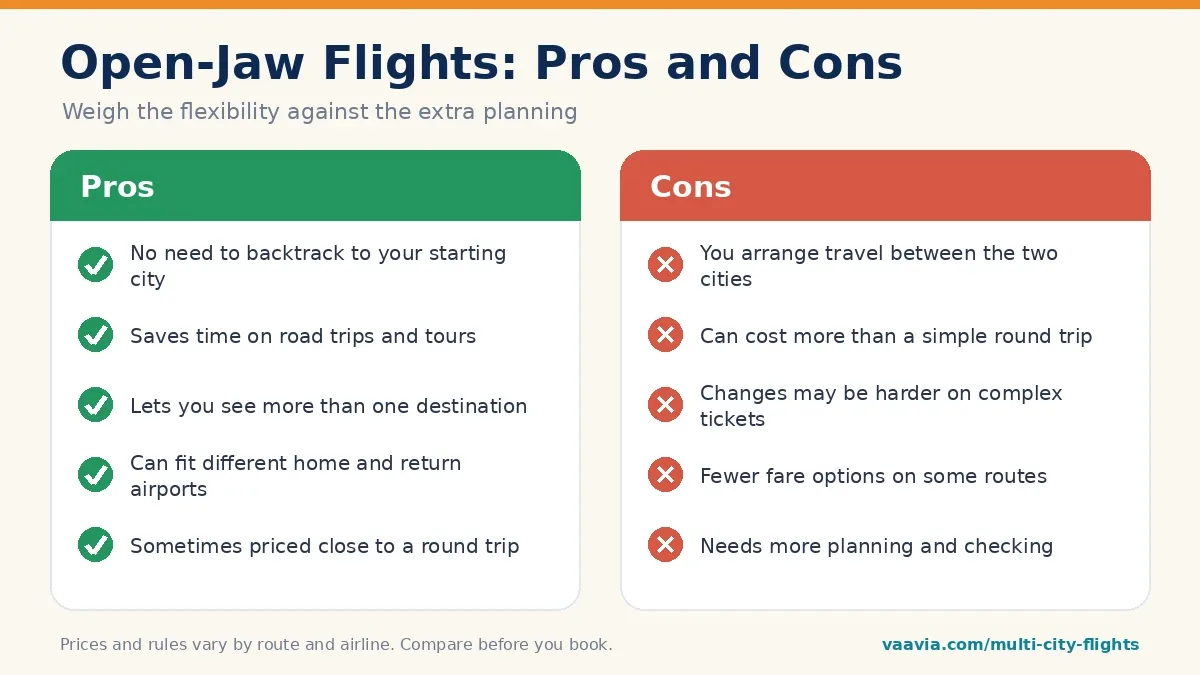
- No backtracking: You do not need to return to your starting city, which saves time and effort.
- Better use of your vacation: You can see more places without repeating the same route.
- Fits road trips and rail journeys: It is a great match for linear trips, such as traveling along a coastline.
- Different home and return airports: If you live between two airports, an open jaw can match your real life.
- Can be priced like a round trip: In some cases, the fare is close to a normal round trip, though this is not guaranteed.
- Flexible planning: You can design your trip around what you want to see instead of what a standard ticket allows.
Drawbacks to Consider
- You arrange the gap: Travel between the two cities is not included, so you need to plan and pay for it.
- Can cost more: Some open-jaw tickets cost more than a simple round trip, especially if the cities are far apart.
- Changes can be harder: Complex tickets may have stricter rules for changes and cancellations.
- More planning needed: You must check dates, distances, and connections yourself.
- Fewer fare options: Some budget fares and promotions are only available on simple round trips.
- Risk of a missed connection on separate tickets: If you book the ground or extra flight leg separately, a delay on one ticket does not protect the next.
Are Open-Jaw Flights More Expensive?
Sometimes, but not always. The price depends on the airline, route, season, and how far apart your two cities are. In some cases, an open-jaw costs about the same as a regular round trip. In others, it costs more, because the airline prices each leg differently.
The only reliable way to know is to compare. Search a simple round trip first, then search the open-jaw version with the same dates. Add the cost of getting from one city to the other, and compare the total. If the open-jaw saves you a long drive back or an extra night, it may be worth a higher fare.
Who Should Book an Open-Jaw Flight?
An open-jaw is a good fit if you:
- Plan a road trip or rail journey that goes from one place to another
- Want to visit two cities or countries without repeating the same route
- Live near more than one airport
- Combine work and leisure in different cities
- Are moving and want to travel from your old home to your new one
- Prefer flexible planning over the simplest ticket
You may prefer a simple round trip if you want the lowest price and the least planning, or if you will be staying in one place the whole time.
How to Book an Open-Jaw Flight, Step by Step
- Plan your route. Decide where you will land, where you will depart from, and how you will travel between those two places.
- Choose your dates. Allow enough days in each city so you are not rushing.
- Use a multi-city or advanced search. Most booking tools have this option. Enter your first flight from A to B, then your second flight from C to A.
- Compare with a round trip. Search the same dates as a standard round trip and compare the prices.
- Add the ground travel cost. Include trains, buses, rental cars, or extra flights in your comparison.
- Check the fare rules. Look at baggage, change, and refund rules before you pay.
- Match names to your ID. Enter names exactly as they appear on your passport or ID.
- Save your confirmation. Keep your itinerary and booking details in one place.
If your search tool does not show open-jaw options clearly, ask a booking specialist or airline representative for help.
Open-Jaw Flight Booking Tips
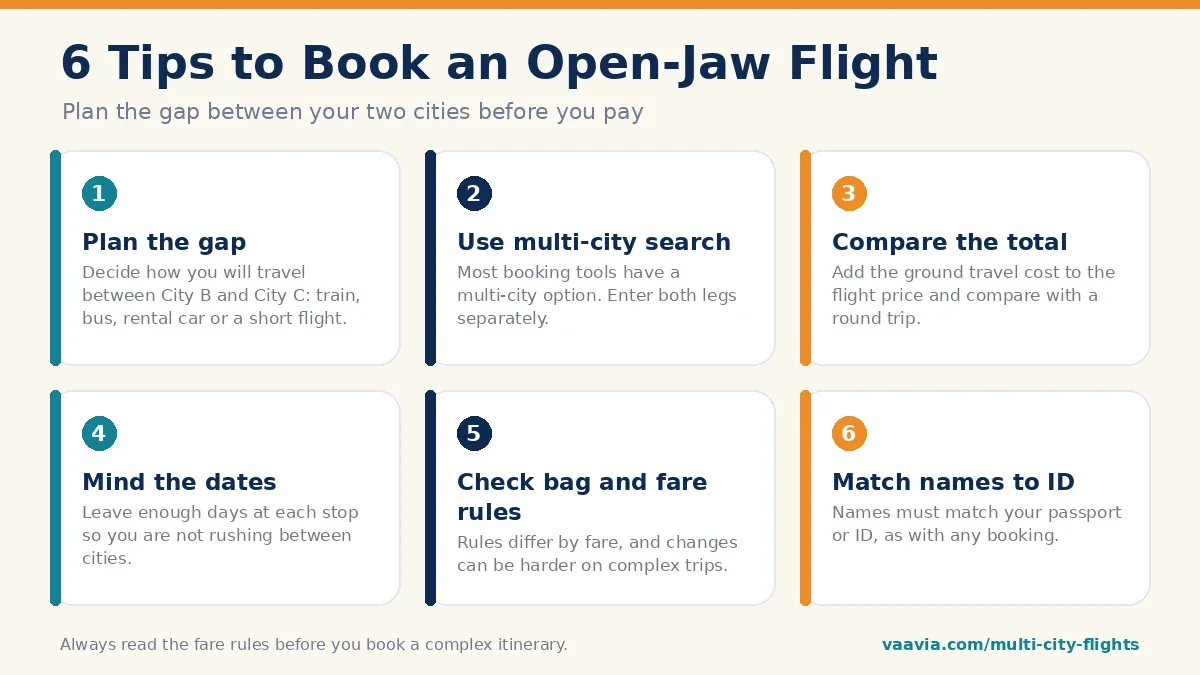
- Plan the gap first. Know how you will get from City B to City C before you book the flights.
- Compare the total cost. The best deal is not always the cheapest flight. Add all your travel costs together.
- Check nearby airports. Sometimes flying into or out of a nearby airport lowers the price.
- Mind the dates. Leave enough time between your arrival and your departure, so you are not rushing.
- Look at baggage rules. Fees and limits can differ by fare and airline.
- Book early for peak seasons. Summer and holiday weeks sell out fast, especially on popular routes.
- Use fare alerts. Track prices for both legs so you can book when fares are low.
- Keep your documents ready. For international trips, check passport and entry requirements for each country you visit.
Changes, Cancellations, and Refunds
Because open-jaw tickets are more complex, changes can be harder than on a standard round trip. Before you book, check the fare rules for changes, cancellations, and refunds. Some fares allow free changes, others charge a fee, and basic fares may have strict limits.
If you need to change a date or route, contact the airline or your booking provider as early as you can. In the USA, many bookings made directly with an airline at least seven days before departure may be cancelled within 24 hours for a full refund, but rules can change, so confirm the current policy. If you booked through an agency, you may need to go through them for changes.
Think about a flexible fare if your plans might shift, and consider travel insurance for expensive international trips.
International Open-Jaw Trips
Open-jaw tickets are especially popular for international travel because they make it easy to visit more than one country. A few extra things to check:
- Passport validity: Many countries require your passport to be valid for several months beyond your travel dates.
- Visas and entry rules: Each country you visit may have its own requirements.
- Overland travel: Check whether border crossings, train routes, or ferries are available and how long they take.
- Travel time between cities: Make sure you leave enough time to reach your departure airport.
- Currency and costs: Prices for ground travel and food can vary a lot between countries.
Common Mistakes to Avoid
- Forgetting the cost of the gap. A cheap flight can become expensive once you add the ground travel.
- Cutting the schedule too tight. Delays can ruin a tight connection between cities.
- Booking separate tickets without a buffer. A delay on the first ticket does not protect the second.
- Skipping the fare rules. Complex tickets may have stricter change and refund conditions.
- Not comparing with a round trip. A simple ticket may be cheaper and just as practical.
- Mismatched names. A name change after booking can be difficult and costly.
- Ignoring entry requirements. Visa or passport problems can end a trip before it starts.
- Waiting too long to book. Popular routes and dates can sell out.
Quick Checklist
Before you book an open-jaw flight, ask yourself:
- Do I really need to land and depart from different cities?
- How will I travel between those two cities, and what will it cost?
- Did I compare the total with a simple round trip?
- Have I allowed enough time in each city?
- Do I understand the baggage, change, and refund rules?
- Do my names match my passport or ID?
- Have I checked passport and entry requirements for every country?
If you can answer yes to all seven, you are ready to book.
Plan Your Trip With Vaavia
An open-jaw flight can turn a simple trip into a smoother, more flexible journey, especially if you want to see more than one place. Plan the route, compare the full cost, and read the fare rules before you pay.
Vaavia can help you compare flights, understand fare rules, and find a route that fits your plans. Browse current flights, or request a callback to talk through your itinerary with a booking specialist.
Frequently Asked Questions
What is an open-jaw flight?
An open-jaw flight is a round-trip style ticket where you arrive in one city and depart from a different one, or start in one city and return to another. You travel the gap between the two cities on your own.
Why is it called an open-jaw flight?
When you draw the route on a map, there is a gap between two of the points, like an open mouth. That gap is the part you travel yourself.
What is a double open-jaw flight?
A double open-jaw is a ticket where both ends of the trip are different. For example, you fly from City A to City B, then return from City C to City D.
Is an open-jaw flight cheaper than two one-way flights?
Sometimes. It can be priced like a round trip, which may be cheaper than two separate one-way tickets, but it depends on the airline and route. Always compare both options.
Is an open-jaw the same as a multi-city flight?
Not exactly. An open-jaw is a type of multi-city trip with two flights where the cities do not match. A multi-city itinerary can include three or more flights.
How do I book an open-jaw flight?
Use the multi-city or advanced search on a booking site, enter your outbound flight and your return flight from a different city, and compare the total with a standard round trip.
Can I change or cancel an open-jaw ticket?
Often yes, but rules depend on the fare and airline. Check the change and refund rules before you book, and contact your airline or booking provider early if your plans change.
Is an open-jaw flight good for international travel?
Yes, especially when you want to visit more than one country. Just check passport validity, visa rules, and how you will travel between the two cities.