





Domestic vs International Business Class: What Changes?
Understand the differences between domestic and international Business Class flights. Compare seats, comfort, meals, baggage allowances, airport services and ticket conditions before choosing your next flight.
Last updated Nov 22, 2026
Business Class can offer a more comfortable and convenient travel experience, but the services and features are not always the same on every flight. One of the biggest differences travelers notice is between domestic and international Business Class.
A domestic Business Class journey usually involves travel between cities within the same country. An international Business Class journey takes passengers across national borders and may involve longer flight durations, different aircraft, additional airport procedures and more extensive onboard services.
However, the difference is not simply about the destination. Aircraft type, flight distance, operating airline, route, cabin configuration and ticket conditions can all influence what a passenger receives.
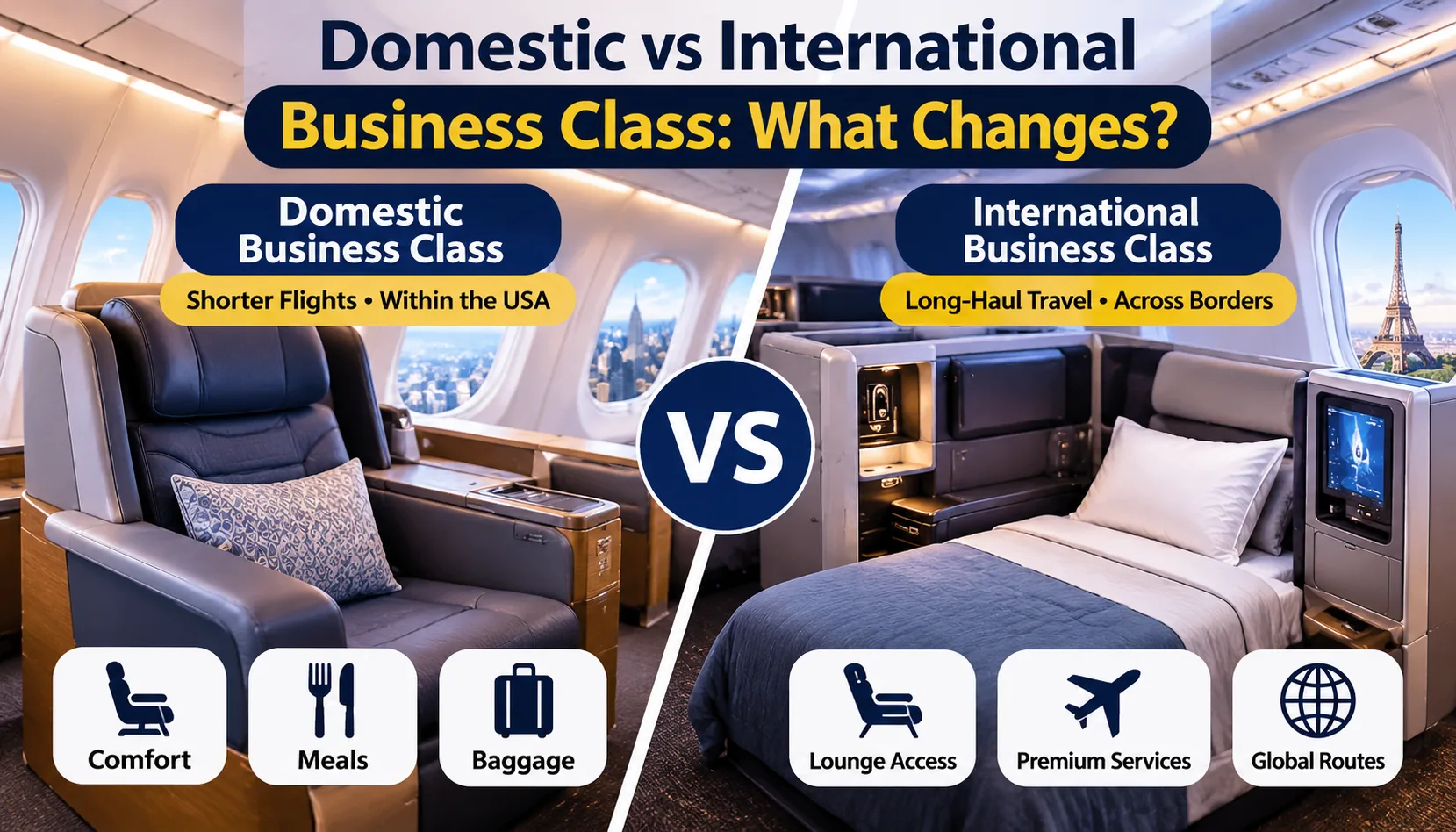
For example, a short domestic flight may offer a spacious reclining seat and limited meal service, while a long-haul international flight may offer a lie-flat seat, a more extensive dining experience and additional cabin features. But these are not universal rules. Some domestic flights have premium seating, and some short international flights offer a cabin similar to domestic services.
If you are comparing domestic vs international Business Class flights, understanding these differences can help you choose an itinerary that fits your travel plans, comfort expectations and budget.
This guide explains what changes between the two types of journeys, which features matter most and what you should check before booking.
Quick Answer: What Is the Difference Between Domestic and International Business Class?
The main difference between domestic and international Business Class is the type of journey and the services provided on the specific flight.
Domestic Business Class is designed for travel within one country. Depending on the route and aircraft, it may offer priority airport services, a wider seat, additional baggage allowance, onboard refreshments or meals, and other premium-cabin benefits.
International Business Class is designed for cross-border travel. On longer routes, it may offer lie-flat seating, more extensive dining, additional personal space, entertainment features and eligible airport lounge access.
Comparison | Domestic Business Class | International Business Class |
|---|---|---|
Journey | Within one country | Between countries |
Typical flight duration | Often shorter | Can be short, medium or long-haul |
Seating | Reclining or premium seats | Reclining, angled-flat or lie-flat seats |
Meals | May be limited or route-dependent | May offer more extensive meal service |
Baggage | Depends on ticket and route | Depends on ticket and route |
Lounge access | Depends on eligibility | Depends on eligibility |
Airport procedures | Domestic airport procedures | International travel and border requirements |
Travel documents | Usually domestic identification requirements | Passport, visa or other documents where required |
Onboard experience | Often focused on shorter journeys | May include additional long-haul comfort features |
Important: These are general comparisons, not guaranteed inclusions. Always check the specific flight and fare conditions before booking.
1. Domestic vs International Business Class: Understanding the Journey
The first difference is the type of journey you are taking.
What Is Domestic Business Class?
Domestic Business Class refers to a premium cabin or premium-cabin service on a flight operating within the same country.
For example, a traveler flying from New York to Los Angeles or Chicago to Miami is taking a domestic journey within the United States.
Domestic Business Class may be available on selected routes and aircraft. Depending on the flight, passengers may receive:
A wider or more comfortable seat
Additional personal space
Priority check-in, where available
Priority boarding, where available
Additional baggage allowance, depending on the fare
Onboard refreshments or meals, depending on the route
Access to eligible airport lounges, where included
The exact experience can vary considerably. A short domestic flight may have a different cabin and service arrangement from a longer domestic route.
What Is International Business Class?
International Business Class refers to a premium cabin on a flight that travels between countries.
Examples include:
New York to London
Los Angeles to Paris
Chicago to Tokyo
San Francisco to Singapore
Dallas to Frankfurt
Boston to Dubai
International Business Class may be designed to support longer journeys, particularly on long-haul routes.
Depending on the aircraft and ticket, features may include:
Spacious premium seating
Lie-flat or reclining seats
More extensive meal service
In-flight entertainment
Additional storage and personal space
Eligible airport lounge access
Priority airport services
Route-specific baggage benefits
Not every international flight offers the same premium cabin. A short international flight can have a simpler seat and service arrangement than a long-haul journey.
2. Seat Comfort: One of the Biggest Differences
Seat design is one of the most important features to compare when choosing between domestic and international Business Class.
The cabin name alone does not tell you how comfortable the seat will be.
Domestic Business Class Seats
Domestic premium-cabin seats are often designed around shorter flight durations.
Depending on the aircraft, you may find:
Wider seats than standard Economy seating
More legroom
Greater seat recline
Additional personal space
Improved access to charging or storage features on selected aircraft
Some domestic aircraft have a dedicated premium cabin, while others may offer different seating configurations.
A wider reclining seat can be comfortable for a short journey, but it does not necessarily provide a flat sleeping surface.
International Business Class Seats
International Business Class seats can vary significantly depending on the aircraft and route.
On many long-haul flights, passengers may find features such as:
Lie-flat sleeping surfaces
Direct aisle access
Greater privacy
Adjustable seating positions
Additional personal storage
Individual entertainment screens
Charging facilities
However, not every international Business Class seat is lie-flat. Some aircraft use angled-flat or reclining seats, and some shorter international routes may offer a more basic premium-cabin arrangement.
What Does Lie-Flat Seating Mean?
A lie-flat seat converts into a flat surface that allows passengers to rest in a horizontal sleeping position.
This can be particularly useful on overnight international flights, where travelers may want to sleep during the journey.
Before booking, check:
Whether the seat converts into a fully flat bed.
Whether the seat has direct aisle access.
Whether the cabin uses a staggered or other seating layout.
Whether the seat has enough personal storage.
Whether the aircraft shown for the flight is the one expected to operate.
Aircraft assignments can change, so seat details should always be checked against the latest available flight information.
For a deeper explanation, read Lie-Flat Business Class Flights: How to Find the Best Seats for Long-Haul Travel.
3. Flight Duration and Comfort Requirements
Flight duration can change how important certain Business Class features become.
A seat that feels comfortable for a two-hour flight may not provide the same level of rest on a long overnight journey.
Short Domestic Flights
Domestic flights often involve shorter travel times, although some journeys within large countries can be several hours long.
For shorter flights, travelers may prioritize:
Convenient departure times
Comfortable seating
Faster airport processes, where available
Convenient boarding
A suitable arrival time
Simple baggage arrangements
A lie-flat seat may not be necessary for every short journey. The value of a premium seat depends on the duration of the flight and your personal requirements.
Long-Haul International Flights
Long-haul international journeys can involve many hours in the air.
For these trips, travelers may place greater importance on:
Sleeping comfort
Seat recline and bed configuration
Personal space
Meal timing
Entertainment
Cabin privacy
Access to power outlets
Baggage arrangements
Connection duration
For example, someone flying overnight from the United States to Europe may prioritize a lie-flat seat and arrival time, while someone taking a daytime international flight may place more importance on seating space, meals and entertainment.
Booking tip: Compare the actual flight duration and cabin features rather than assuming that every international Business Class flight is more comfortable than every domestic one.
4. Meals and Onboard Dining: What Changes?
Food and beverage service can differ between domestic and international Business Class flights.
However, the length of the flight, route, operating airline and service schedule all matter.
Domestic Business Class Meals
On domestic routes, onboard dining may depend on the flight duration and service arrangements.
Depending on the journey, passengers may receive:
Snacks
Light refreshments
Drinks
A meal service on selected flights
Special meals where available and requested according to the applicable rules
Short flights may have limited onboard service because of the time available.
International Business Class Meals
International Business Class on longer routes may offer a more extensive dining experience.
Possible features include:
Multiple meal services
A choice of main dishes
Appetizers and desserts
Beverage service
Breakfast on selected overnight journeys
Special meals where available
Meal availability and timing can vary. A short international flight may offer a limited service, while a longer flight may provide multiple meal periods.
What Should You Check Before Booking?
If dining is important to you, review:
Whether meals are included.
Whether the flight offers a full meal or light refreshments.
Whether special meals can be requested.
How far in advance a special meal must be requested.
Whether the service applies to every flight segment.
Do not assume that a meal service is identical on outbound and return flights.
5. Baggage Allowance: Domestic vs International Business Class
Baggage allowance is another important factor when comparing domestic and international Business Class.
Premium-cabin tickets may offer different baggage conditions from Economy, but the allowance is not universal.
Domestic Business Class Baggage
Domestic baggage rules depend on the specific route and ticket conditions.
Before traveling, check:
Number of checked bags included
Maximum weight per checked bag
Carry-on baggage allowance
Personal item rules
Oversized baggage conditions
Additional baggage charges, if applicable
Some itineraries may have different rules depending on the fare purchased.
International Business Class Baggage
International Business Class tickets may include a different checked baggage allowance, depending on the route and fare.
Travelers should confirm:
Number of permitted checked bags
Weight limits
Carry-on baggage allowance
Size restrictions
Special baggage conditions
Baggage rules for connecting flights
What If Your International Journey Has Multiple Flights?
This is particularly important when your itinerary includes more than one flight segment.
For example, a traveler may have a domestic flight within the United States followed by an international departure.
In this situation, check the baggage rules for the complete itinerary. Do not automatically assume that the baggage allowance shown for one segment applies to every flight.
If the flights are on separate tickets, baggage handling and recheck requirements may be different.
Practical tip: Always confirm the baggage allowance shown in your actual booking details rather than relying on general Business Class baggage expectations.
6. Airport Experience: Check-In, Boarding and Lounge Access
Airport services can be different between domestic and international journeys.
Some Business Class benefits may be available on both types of flights, but eligibility and availability depend on the ticket and airport.
Domestic Business Class Airport Services
Depending on the ticket and airport, domestic premium-cabin passengers may have access to:
Dedicated or priority check-in
Priority boarding
Priority baggage handling
Eligible lounge facilities
Additional airport assistance
Not every domestic airport has the same facilities, and lounge access is not automatically included with every premium-cabin ticket.
International Business Class Airport Services
International Business Class tickets may offer similar priority services, along with access to eligible international airport lounges where the ticket conditions permit it.
Depending on the airport and ticket, passengers may also find:
Dedicated premium check-in areas
Priority boarding
Eligible departure lounges
Lounge facilities at selected connecting airports
Priority baggage services
Additional airport assistance
Does Business Class Automatically Include Lounge Access?
No. Lounge access depends on the ticket, operating airline, airport, applicable access agreement and other eligibility conditions.
Before booking, confirm:
Whether lounge access is included.
Which lounge you can use.
Whether access applies at the departure airport.
Whether a connecting-airport lounge is included.
Whether guest access is permitted.
Whether the lounge will be open at your travel time.
This is especially important for travelers with long layovers.
7. Domestic vs International Business Class: Travel Documents and Airport Procedures
The documentation required for domestic and international flights is not the same.
Domestic Travel Documents
For domestic travel within the United States, passengers generally need identification that meets the applicable transportation security requirements.
The exact identification requirements depend on the passenger and the current rules.
Travelers should check the official requirements before departure and make sure their identification is valid.
International Travel Documents
International travel usually requires additional preparation.
Depending on the destination and passenger's nationality, travelers may need:
A valid passport
A destination visa
An electronic travel authorization
Transit documentation
Proof of onward or return travel, where required
Supporting documents for the purpose of travel
Requirements can also depend on whether a passenger is transiting through another country.
Does Business Class Make Immigration Easier?
A Business Class ticket does not remove immigration or entry requirements.
Passengers must still follow the applicable passport, visa, customs, security and border-control procedures.
Priority airport services, where offered, should not be confused with permission to bypass immigration rules.
Important: Check official government or immigration information for your nationality, destination and transit points before departure.
8. Ticket Prices and Fare Conditions: Why They Can Differ
Domestic and international Business Class tickets can differ in price, but there is no universal price rule.
The total cost of a premium-cabin itinerary may depend on:
Travel dates
Route and distance
Seasonal demand
Cabin availability
Flight duration
Number of connections
Fare type
Ticket flexibility
Included services
Departure and arrival airports
International flights may involve longer journeys and different cabin products, but a domestic premium-cabin ticket can also vary significantly depending on route and demand.
Compare More Than the Displayed Ticket Price
Before making a booking decision, review what the fare actually includes.
Fare detail | Why it matters |
|---|---|
Checked baggage | Helps you understand the included allowance |
Seat selection | Confirms whether advance selection is included |
Changes | Shows whether changes are permitted and what charges may apply |
Cancellation | Explains whether cancellation is allowed |
Refundability | Clarifies whether a refund may be available |
Flight connections | Helps identify separate-ticket or transfer conditions |
Included services | Shows what the ticket actually provides |
A lower displayed fare may have different restrictions from another fare in the same cabin.
For travelers with changing plans, flexibility may be an important part of the booking decision.
9. Is Domestic Business Class Worth It for Short Flights?
Domestic Business Class may be useful for travelers who value comfort, additional space or eligible priority services, even on shorter journeys.
It can be worth considering when:
You have a busy travel schedule.
You need more personal space.
You want a more convenient airport experience.
You are traveling for business.
You have an important meeting after arrival.
You prefer a premium cabin experience.
However, it may not be necessary for every short journey.
Consider the actual flight duration, seat configuration, included services and difference in ticket conditions before deciding.
A premium seat on a short flight may provide comfort, but it may not deliver the same benefits as a long-haul international Business Class cabin.
10. Is International Business Class Worth It for Long-Haul Travel?
International Business Class can be particularly useful for travelers taking long-haul or overnight journeys.
The benefits that matter most depend on the actual flight and cabin.
Travelers may consider it when they want:
More comfortable seating
A lie-flat sleeping surface, where available
More personal space
A different onboard dining experience
Eligible airport lounge access
Priority airport services
A more comfortable long-distance journey
For example, a traveler flying from the United States to Asia may spend many hours in the air. In that situation, seat design and sleeping comfort may be important considerations.
However, international Business Class is not automatically the right choice for every passenger. A shorter international journey may not require the same cabin features as an overnight long-haul flight.
The best decision depends on your travel duration, schedule, preferences and ticket conditions.
11. Domestic First Class vs Domestic Business Class: Is There a Difference?
Travelers searching for domestic Business Class flights in the United States may also come across the term "First Class."
This can create confusion because cabin naming conventions vary by market and operating airline.
On many US domestic routes, the premium cabin is commonly marketed as First Class rather than Business Class. In other markets or on particular routes, the terminology may differ.
The important point is to compare the actual cabin product rather than relying only on its name.
Check:
Seat width and pitch
Seat recline
Cabin layout
Meal service
Baggage allowance
Priority airport services
Lounge eligibility
Fare conditions
A cabin called First Class on a domestic route does not necessarily provide the same experience as international long-haul First Class.
Likewise, a domestic premium cabin should not automatically be assumed to match an international Business Class suite.
12. Which Business Class Should You Choose?
The right option depends on the purpose and duration of your trip.
Your travel situation | What to prioritize |
|---|---|
Short domestic business trip | Convenient schedule, comfortable seat and arrival time |
Long domestic journey | Seat comfort, baggage and onboard service |
Short international flight | Route, seat layout and airport requirements |
Overnight international flight | Lie-flat seating, sleep comfort and arrival time |
Long-haul international journey | Cabin layout, meals, baggage and total journey |
Family travel | Seating arrangements, baggage and connection duration |
Corporate travel | Schedule, ticket flexibility and passenger requirements |
Multi-city international trip | Flight sequence, connections and ticket conditions |
Example 1: New York to Los Angeles
This is a domestic journey within the United States.
A traveler comparing premium-cabin options may focus on seat comfort, flight timing, baggage and airport convenience.
A lie-flat bed may not be necessary for every passenger on this route.
Example 2: New York to London
This is an international journey between the United States and the United Kingdom.
A traveler may place greater importance on overnight comfort, seat configuration, meal service and arrival timing.
Example 3: Los Angeles to Tokyo
This is a long-haul international journey.
Seat design, sleeping comfort, cabin privacy, entertainment and baggage conditions may play a more important role in the booking decision.
These examples illustrate how travel duration and journey type can affect your priorities. Actual aircraft, services and ticket inclusions must be checked for the selected flight.
13. What to Check Before Booking Domestic or International Business Class
Before confirming your ticket, use this practical checklist.
Flight Details
Confirm the departure and arrival airports.
Check whether the journey is domestic or international.
Confirm the departure and arrival dates.
Review the total flight duration.
Check whether the flight is nonstop or connecting.
Review the aircraft information where available.
Seat and Cabin
Check the actual seat configuration.
Confirm whether the seat reclines or converts into a flat bed.
Review aisle access and personal space.
Check seat-selection conditions.
Review cabin features for every flight segment.
Services and Baggage
Confirm checked baggage allowance.
Check carry-on baggage rules.
Review meal and refreshment services.
Confirm lounge access eligibility.
Check priority check-in and boarding conditions.
Review special assistance requirements if applicable.
Ticket and Travel Documents
Read change and cancellation rules.
Check refund conditions.
Verify passenger details.
Confirm passport and visa requirements for international travel.
Check transit requirements for connecting journeys.
Save your booking confirmation and ticket information.
This checklist helps you compare the actual benefits of each ticket instead of relying only on the cabin label.
14. How Vaavia Helps Travelers Compare Business Class Booking Options
Choosing between domestic and international Business Class requires attention to the route, travel dates, cabin arrangement and ticket conditions.
Vaavia is an independent travel agency that provides flight booking assistance for travelers planning domestic and international journeys from the United States.
When reviewing a Business Class booking enquiry, the important details include:
Departure and arrival cities
Preferred travel dates
One-way or round-trip requirements
Number of passengers
Nonstop or connecting preferences
Domestic or international travel
Seat and cabin preferences
Baggage requirements
Ticket change and cancellation conditions
For travelers comparing premium-cabin options, reviewing these details together can help identify which itinerary better matches their requirements.
You can explore Vaavia's Business Class flight booking page for information about its Business Class booking assistance.
Frequently Asked Questions
What is the difference between domestic and international Business Class?
Domestic Business Class is for flights within the same country, while international Business Class is for flights between countries. Seat designs, meal services, baggage rules and airport benefits can vary according to the route, aircraft and ticket conditions.
Is international Business Class better than domestic Business Class?
Not necessarily. International Business Class on long-haul routes may offer lie-flat seating and more extensive onboard services. Domestic Business Class may provide comfortable seating and useful priority services for shorter journeys. The better option depends on your travel requirements.
Are domestic Business Class seats different from international Business Class seats?
They can be. Domestic premium cabins may use wider reclining seats, while some long-haul international Business Class cabins offer lie-flat seats and more privacy. However, aircraft and route differences mean there are exceptions.
Do all international Business Class flights have lie-flat seats?
No. Lie-flat seats are not available on every international route. Some shorter international flights use reclining or other premium-cabin seating arrangements. Always check the actual aircraft and seat configuration before booking.
Does domestic Business Class include meals?
Meal service depends on the flight duration, route and operating airline. Some domestic journeys offer meals, while shorter flights may provide limited refreshments or snacks.
Does international Business Class include more meals?
Longer international flights may offer more extensive meal services, including multiple meal periods. However, service varies by route and flight duration, so passengers should confirm what is included.