


TSA Liquids Rule: The 3-1-1 Carry-On Guide
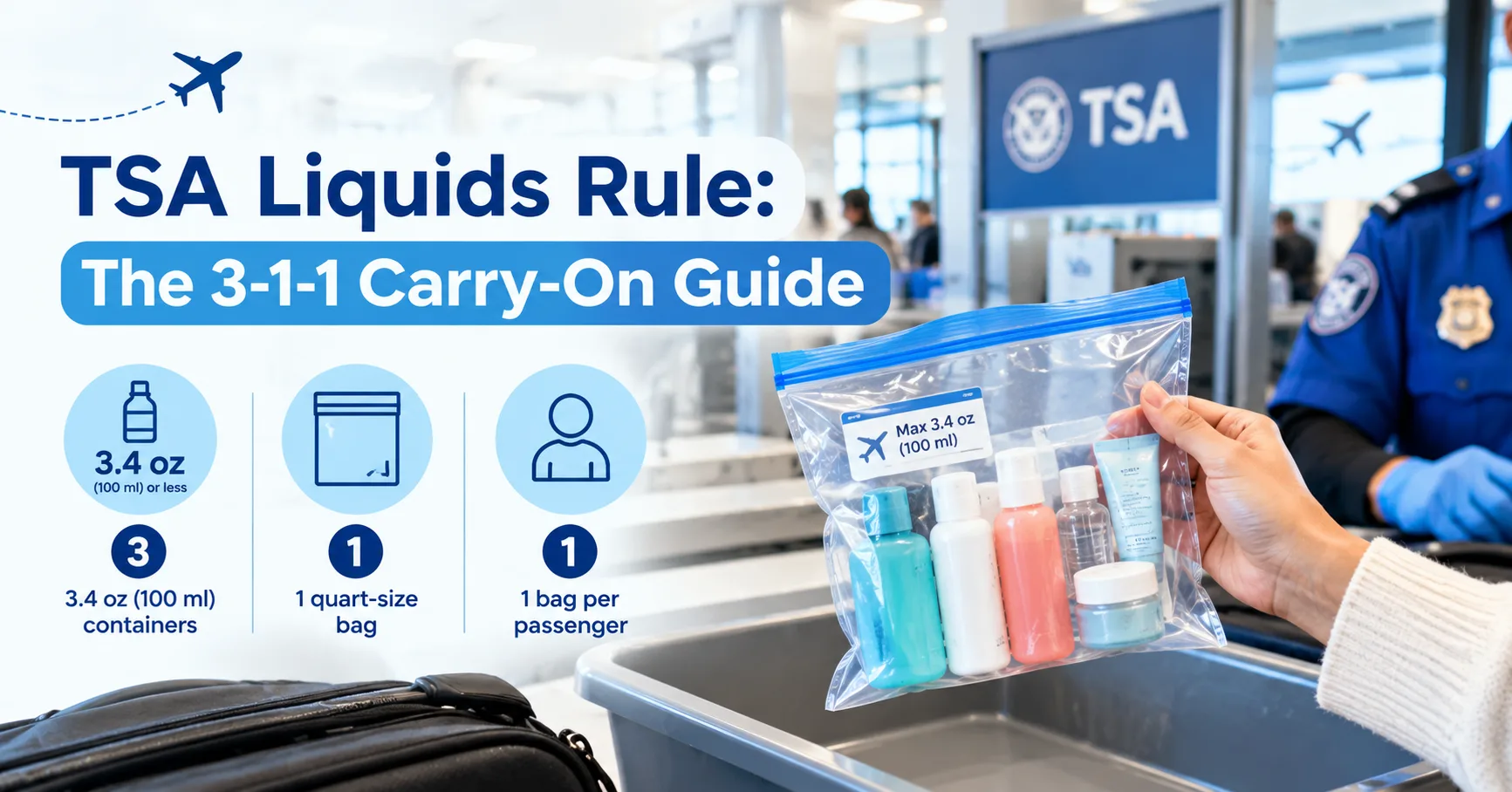
The TSA liquids rule, usually called 3-1-1, lets each passenger carry liquids, aerosols, gels, creams and pastes in containers of 3.4 ounces (100 milliliters) or less, all fitting inside one quart-size bag. Anything larger goes in checked baggage. Medication and nourishment for infants and children are exempt and may exceed the limit.
Last updated Oct 8, 2026
What is the TSA liquids rule?
The TSA liquids rule limits what you may take through a United States security checkpoint: each liquid, aerosol, gel, cream or paste must sit in a container of 3.4 ounces (100 milliliters) or less, every container must fit inside one quart-size resealable bag, and each passenger may bring one such bag. Because it is a screening rule rather than a fare condition, it holds on whatever itinerary you put together in the Vaavia flight search.
3-1-1 liquids rule: TSA's shorthand for its carry-on liquid limit: 3.4-ounce (100-milliliter) containers, 1 quart-size bag, 1 bag for each passenger.
The size printed on the container settles it, not how much is left inside. A nearly empty eight-ounce bottle of lotion is still an eight-ounce bottle to a screening officer.
Keep the two authorities apart: bag sizes, weights and allowances belong to your airline, while what may be inside those bags at the X-ray belongs to TSA.
What counts as a liquid, gel or aerosol?
TSA handles liquids, aerosols, gels, creams and pastes as a single category, so anything that pours, sprays, spreads or squeezes is in scope. Toothpaste, shampoo, conditioner, mouthwash and lotion are the everyday examples TSA names itself.
Food follows the same logic. Food may travel in cabin and checked bags alike, every item is X-rayed, and any food that behaves like a liquid or a gel — yogurt, jam, soup, dips, soft cheese — either meets the 3.4-ounce limit or rides in the hold.
Several things travelers expect to be stopped are not liquids at all: a solid deodorant stick, a bar of soap, powder and solid makeup never touch the quart-size bag. For a specific item, TSA runs a searchable What Can I Bring? tool — and the officer at the lane has the final word whatever a list shows.
How do you pack liquids so screening goes quickly?
Pack the quart-size bag last, keep it where one hand can reach it, and pull out anything exempt before you join the queue. Nearly every hold-up at the liquids bin is a bag buried under folded clothes.
- Decant into travel-size containers. Move shampoo, lotion and gel into containers of 3.4 ounces (100 milliliters) or less, and leave the full-size bottles at home or in a checked bag.
- Seal one quart-size bag. Fit every container inside a single clear, quart-size, zip-top bag and close the seal. If the bag will not shut, something has to come out.
- Set the exempt items aside. Keep medication, formula, breast milk, toddler drinks and their cooling packs out of the quart-size bag, in a pocket you can empty in one movement.
- Pack the bag within reach. Put the quart-size bag in an outside pocket of the bag you will open at the checkpoint, not under the clothes in the main compartment.
- Lift the bag out at the belt. Place the quart-size bag in a bin on its own in a standard lane. In a TSA PreCheck lane it can stay packed, which TSA states plainly.
- Declare what needs declaring. Tell the officer at the start of screening about medication and infant feeds, and put them in their own bin with any pumps, syringes or ice packs.
Anything that alarms during screening gets additional screening, so a clean, see-through bag with nothing taped shut is the fastest version of this.
Where does each kind of liquid belong?
Ordinary toiletries belong in the quart-size bag, anything in a larger container belongs in checked baggage, and medication and infant feeds travel in the cabin outside the quart-size bag. Sealed duty-free is its own narrow case.
| Kind of liquid | Where it belongs | At the checkpoint |
|---|---|---|
| Ordinary toiletries | Quart-size bag in a cabin bag | Lift the bag into a bin |
| Full-size bottles and tubes | Checked baggage | Nothing; they ride in the hold |
| Liquid medication | Cabin bag, outside the quart-size bag | Declare it, ask for separate screening |
| Formula, breast milk, toddler drinks | Cabin bag, reasonable quantity for the trip | Declare it and remove it from the bag |
| Ice, gel and freezer packs | Cabin bag, with what they are cooling | Declare them beside the milk or medicine |
| Sealed duty-free bought abroad | Cabin bag only if every condition is met | Show the unopened bag and the receipt |
That last row carries conditions. Duty-free liquids over 3.4 ounces may stay in a cabin bag when you fly into the United States and connect onward, the retailer's transparent, tamper-evident bag is unopened, you hold the original receipt, the purchase was made within 48 hours, and the contents screen clean. Miss any of those and the bottles belong in a checked bag, which TSA recommends for large duty-free purchases anyway.
Which liquids are exempt from the 3-1-1 limit?
Two groups are exempt: medication, and nourishment for infants and children. Both may exceed 3.4 ounces (100 milliliters), neither has to fit inside the quart-size bag, and both are declared to an officer and screened separately.
- Medically necessary liquids, gels and aerosols, in quantities reasonable for the trip, declared to an officer for inspection.
- Formula, breast milk, toddler drinks and baby or toddler food, puree pouches included, above the usual container limit.
- Ice packs, freezer packs and gel packs that keep those items cool, whether or not there is milk with them.
- Liquid-filled teethers, which TSA allows in a cabin bag.
Your child does not have to be traveling with you for you to carry breast milk and the packs that keep it cold. Parents working out the rest of a trip will find seating and booking advice on our family flight booking page.
Officers may test an exempt liquid for explosives, or ask you to open a container for vapor analysis; TSA states that nothing is ever placed into the liquid, and that its X-ray equipment does not harm food or medicine. You may decline X-ray and opening — say so before screening starts, and expect additional screening of yourself, which can include a pat-down.
A traveler with a medical condition can tell the officer, show a TSA notification card or carry documentation. TSA Cares answers screening questions before a trip through TSA's own help line, and asks for roughly 72 hours' notice. Airline help at the airport, a wheelchair for instance, is arranged separately — see our special assistance flights page.
Do liquid rules change at airports outside the United States?
Yes. TSA screens departures from the United States, so a flight leaving a foreign airport is screened under rules set locally — which may use a different container size, a different kind of bag, or extra conditions on duty-free and on electronics.
Check the departure airport's own published guidance before you pack, and when a trip leaves from two countries, pack to the stricter set of rules. Requirements can also differ between terminals, and between the lane and a second check at the gate.
What do travelers get wrong about the TSA liquids rule?
The commonest mistake is reading 3-1-1 as a limit on total volume. It is a limit on each container and on the one bag they share, so a quart-size bag packed full of correctly sized bottles is fine while one oversized bottle is not, however little is inside it.
- Judging by what is left. A half-used ten-ounce tube is measured by the tube, not by the contents.
- Using a grocery bag. The bag has to be clear, quart-size and resealable, and everything must fit with the seal closed.
- Sharing one bag. Each traveler gets a bag, so a family packs one per passenger rather than one between them.
- Putting medication in the quart-size bag. It belongs outside it, declared, in a bin of its own.
- Forgetting food. Soup, dips, jam and soft cheese are screened as liquids, not as groceries.
- Assuming the sealed bag is enough. Duty-free over the limit also needs the receipt, the timing and a clean screen.
Each of these costs the same thing: an item surrendered at the lane, or a repack in front of the queue.
Where should you go next before you fly?
Go to the page that matches the trip: the domestic page for a flight inside the United States, the international page for anything that crosses a border.
- Domestic flights — what else to check on a U.S. route, from acceptable ID to what a fare includes.
- International flights — passports, entry requirements and the checks worth making before a trip abroad.
A Vaavia travel consultant can go through what a fare includes before you pay, which beats finding out about bags on the morning of the flight.
Sources
- Transportation Security Administration — liquids, aerosols and gels rule
- Transportation Security Administration — What Can I Bring?
- Transportation Security Administration — travel checklist
- Transportation Security Administration — traveling with children
- Transportation Security Administration — disabilities and medical conditions
- Transportation Security Administration — liquid medication
Frequently Asked Questions
Is the TSA liquids limit 3.4 ounces or 100 milliliters?
Both figures describe the same limit. TSA states it as 3.4 ounces or 100 milliliters per container, and every container must fit inside one quart-size bag. Check the size printed on the container, not how much is left inside it.
Can I bring a full-size bottle of shampoo in my carry-on?
No. A container larger than 3.4 ounces (100 milliliters) belongs in checked baggage, because shampoo is not one of TSA's exemptions. Pour what you need into a travel-size container for your quart-size bag, or pack the full bottle in a checked suitcase.
Does liquid medicine have to fit in the quart-size bag?
No. TSA allows medically necessary liquids, gels and aerosols in reasonable quantities for your trip, even above 3.4 ounces. You must declare them to the officer before screening and place them in a separate bin. Clear labeling helps the screening go faster.
Do I need my baby with me to carry breast milk through security?
No. TSA says your child does not need to be traveling with you for you to bring breast milk and cooling accessories such as ice packs. Quantities over 3.4 ounces are allowed, but tell the officer at the start of screening and remove them for separate screening.
Do I have to take my liquids bag out in TSA PreCheck?
No. TSA says that in TSA PreCheck lanes you do not need to remove 3-1-1 liquids from your bag. The container and bag limits still apply, so pack them the same way. In a standard lane, take the quart-size bag out and place it in a bin.
Can I take sealed duty-free liquids through a U.S. connection?
Sometimes. Bottles over 3.4 ounces may stay in a cabin bag when you fly into the United States and connect onward, the retailer's transparent tamper-evident bag is intact, you hold the original receipt from within 48 hours, and the contents screen clean. Otherwise they belong in checked baggage.