



Carry-On vs Personal Item: What Goes Where
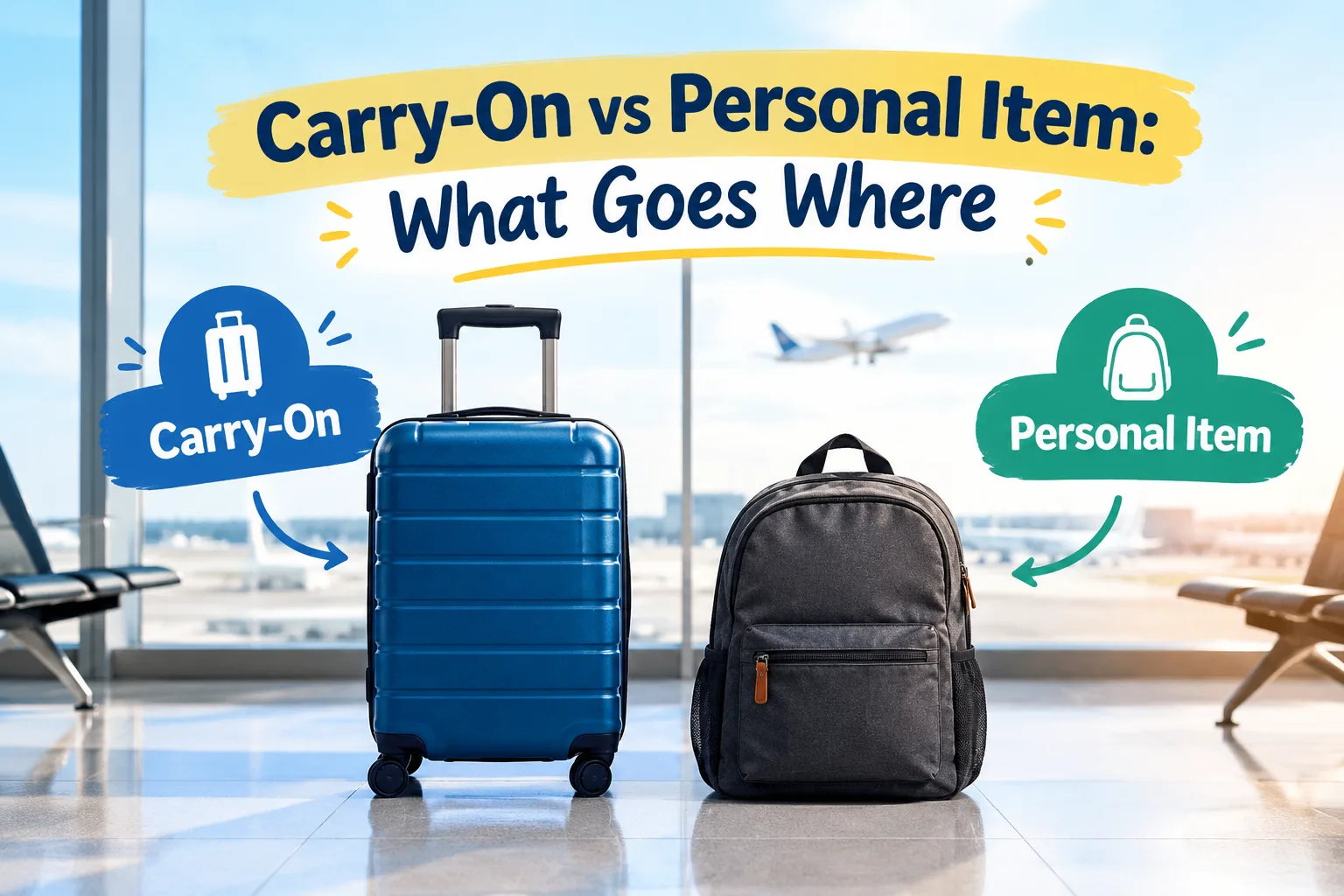
Carry-on vs personal item is a question of size and storage. A personal item is the smaller bag that must fit under the seat in front of you, and a carry-on is the larger bag that rides in the overhead bin. Each airline sets the dimensions for both, and your fare decides whether you get one of each.
Last updated Oct 11, 2026
What is the difference between a carry-on and a personal item?
The difference is where the bag travels and how big it is allowed to be. A personal item stays at your feet for the whole flight; a carry-on bag is lifted into the overhead bin. Both ride in the cabin with you, both pass through security, and both are counted separately against your allowance. When you compare itineraries in the Vaavia flight search, read the baggage line beside the fare, because that line often matters more to the trip than a small difference in the fare itself.
Personal item: A personal item is a small bag, such as a purse, laptop bag, tote or compact backpack, that has to fit completely under the seat in front of you.
Carry-on bag: A carry-on bag is the larger cabin bag, usually a small wheeled case or travel backpack, that is stowed in the overhead bin for the flight.
Because the two are counted separately, two travelers in the same row can hold different rights to the bin above them. The seat comes with the ticket; the overhead space comes with the fare, and the cheaper fare on the same flight is the one most likely to leave it out.
Who sets carry-on vs personal item size limits?
Your airline sets carry-on vs personal item size limits, and no federal agency sets a national standard for either bag. The dimensions that apply to your trip are the ones published by the airline carrying you, for the exact fare you bought.
The figure quoted most often for a cabin bag, about 22 x 14 x 9 inches including wheels and handles, is a maximum that many carriers in the United States happen to share. It is a common industry figure, not a rule anyone is obliged to follow. Use it to shop for luggage, then verify it against your own airline, because a regional aircraft, a carrier based abroad or a restricted fare can all come in under it.
- The airline decides the dimensions, any weight limit, how many bags you may bring, and what happens to a bag that does not fit the sizer.
- Security screening decides what may be packed inside either bag, which is a separate question from how large the bag is.
- Your fare decides whether a full-size carry-on is part of the ticket at all, or whether only the personal item is included.
That split explains most of the trouble people meet at the airport. A bag can clear the checkpoint without a word and still be refused at the gate for being too large, and a bag that fits the sizer perfectly can be pulled aside at screening over something packed inside it. Neither outcome contradicts the other.
So the reliable source for size is the baggage page on your airline's own website, read for your fare rather than for the airline in general. On a trip abroad the numbers usually tighten, and weight starts to count as much as shape — our international flights page covers the other checks worth making before a long journey.
On a smaller aircraft your carry-on may be tagged at the aircraft door and returned to you at the end of the flight. Keep medicines, documents, keys and anything valuable in the personal item, so they stay with you if that happens.
How do you check your bags will be accepted before you leave home?
Check them by measuring both bags packed, against the limits published for your own fare, while you are still standing in your hallway. Five minutes with a tape measure is easier than repacking on the jet bridge, and far easier than paying for a bag at the gate.
- Read the baggage line on your own fare. Open the confirmation and find what the ticket actually includes. A carry-on listed on the airline's general baggage page is not necessarily part of the fare you bought.
- Measure both bags fully packed. Stand the carry-on upright, measure from the floor to the top of the handle, and take the depth with the front pockets full. A soft bag that passes empty can bulge past the limit loaded.
- Weigh the carry-on if a weight limit applies. Some airlines publish a cabin weight limit and some do not. Where one exists, bathroom scales at home answer the question before the check-in desk does.
- Test the personal item against a real gap. A compressible bag that slides into a narrow space at home will slide under a seat. A rigid case that will not compress is the one that comes back out.
- Move the essentials into the personal item. Medication, identification, chargers, keys and valuables belong in the bag that never leaves your side, whatever happens to the larger one.
- Ask before you pay if anything is unclear. A Vaavia travel consultant can read the baggage terms of a fare to you before you commit to it.
Do this once per airline and you will remember it for the next trip. Do it again when the itinerary involves more than one carrier, because the allowance you packed for may not be the one that applies on the second leg.
Which bag goes where, and what limit applies to each?
Each bag has one place it belongs and one source for its limit. The table below sets out where every bag on a normal trip travels, and how the limit for it is usually expressed.
| Bag type | Where it goes | Typical limit wording |
|---|---|---|
| Personal item | Under the seat in front of you | Varies by airline; must fit the under-seat space |
| Full-size carry-on | In an overhead bin | Varies by airline, measured with wheels and handles |
| Gate-checked carry-on | In the hold, returned on arrival | Varies by airline and by aircraft size |
| Checked bag | In the hold, collected at baggage claim | Varies by airline, fare and route |
| Coat, umbrella or duty-free purchase | Carried, or packed inside another bag | Varies by airline; sometimes counted, sometimes not |
Note the last row. An item one airline waives can be counted against the allowance on a different carrier, so settle it before you reach the gate.
Traveling as a group changes the arithmetic too, because every ticketed traveler normally carries an allowance of their own, children on their own seats included. Our family flight booking page covers how that sits alongside seating and check-in.
What do travelers get wrong about carry-on and personal item sizes?
The most common mistake is treating a familiar number as a rule. Sizes belong to each airline and to each fare, so the figure that worked on the last trip may not apply to this one.
- Measuring the bag empty. Luggage is sold by its stated size, not the size it reaches once packed, and the sizer at the gate measures the packed version.
- Forgetting the wheels and the handle. Where an airline measures the whole bag, the case body alone is not what has to fit.
- Assuming every fare includes the overhead bin. A restricted fare on some airlines covers the personal item only, and adding a bag later can cost more than adding it at booking.
- Packing for the first airline on the ticket. On an itinerary with two carriers, pack for the stricter allowance on the trip.
- Leaving essentials in the carry-on. If the bag is tagged at the aircraft door, medication and documents go into the hold with it.
- Expecting the checkpoint to settle it. Screening clears what is inside the bag; nobody there is checking whether the bag itself fits your airline's sizer.
Every one of these costs something only when it is discovered late, which is the argument for reading the baggage terms on the day you book instead of the morning you fly.
Where should you go next before you book?
Go to whichever page matches the decision in front of you: the fare comparison, where restricted tickets and bag allowances meet, or a plain U.S. route where the carry-on question is usually the only baggage question you have.
- Cheap flights — what a restricted fare leaves out, bags included, and how to compare two fares on what you would really pay.
- Domestic flights — what else to check on a route inside the United States before you buy.
A Vaavia travel consultant can confirm which bags a fare includes before you pay for it, which is the right moment to find out — not at the gate with a packed case and a boarding queue behind you.
Sources
- Transportation Security Administration — What Can I Bring?
Frequently Asked Questions
Can I bring both a carry-on and a personal item on a flight?
Many fares allow one carry-on bag and one personal item for each traveler, but not all of them do. Some restricted fares include only the personal item, so a full-size cabin bag either costs extra or is not permitted. Check the baggage line on your fare before you buy, or ask a Vaavia consultant to confirm it.
Does a backpack count as a personal item or a carry-on?
A backpack can be either one, depending on how big it is. A small pack that fits under the seat in front of you is normally treated as a personal item, while a large travel pack counts as a carry-on bag. Measure it packed and compare it with your airline's published dimensions for each.
Do carry-on size limits include wheels and handles?
On many airlines, yes. The commonly quoted cabin-bag maximum is usually measured with the wheels and the handle included, so measure your case from the floor to the top of the raised handle. Your airline's baggage page states exactly how it takes the measurement, and that page is the one that counts.
What happens if my carry-on is too big at the gate?
The airline can require you to check a bag that will not fit its sizer, and a fee may apply depending on the airline and the fare. The bag then travels in the hold, so move medication, documents and anything valuable into your personal item before you hand it over.
Are carry-on rules different on international flights?
They can be. Airlines flying between countries often publish smaller cabin dimensions, and some apply a firm weight limit that domestic carriers do not. When a trip uses more than one airline, pack for the strictest allowance on the itinerary and read each carrier's own baggage page.
Can I put my personal item in the overhead bin instead?
Usually you can, once boarding is complete and space allows, but it is not the safer choice. Crew may ask for the under-seat space to be used first, and anything you might want during the flight is out of reach up there. Keep medication and documents at your feet.