



Flying with an Infant: Lap, Paid Seat and Car Seat Rules
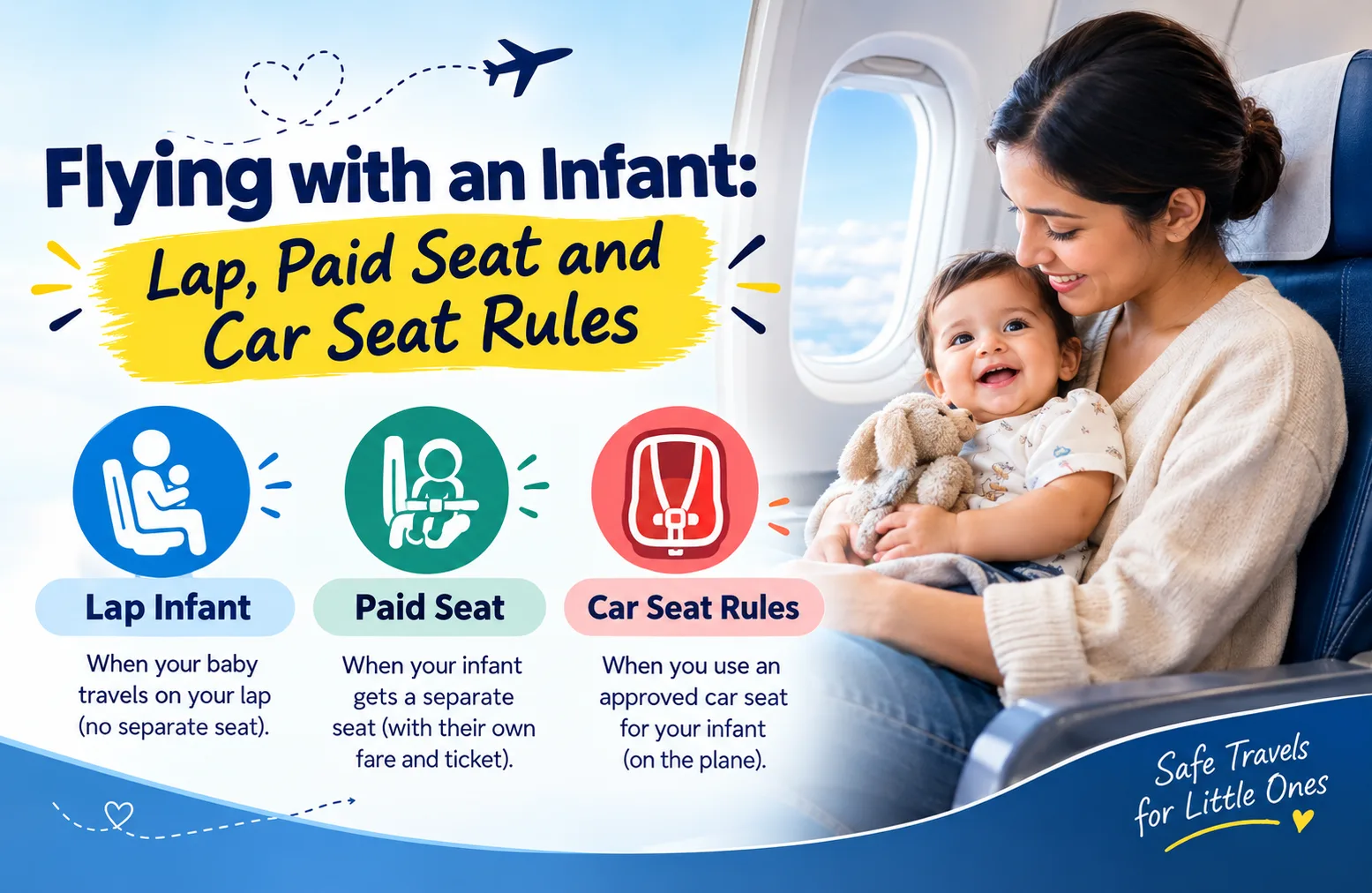
Flying with an infant comes down to one decision: hold the baby on your lap, which federal rules allow until the child's second birthday as long as no restraining device is used, or buy the baby a seat and use a car seat labeled for aircraft. Either way, the baby goes on the booking.
Last updated Oct 11, 2026
What does flying with an infant actually involve?
Flying with an infant means settling three things before you search: whether the baby rides on a lap or in a paid seat, what restraint is allowed once the cabin door closes, and what the airline wants to see at check-in. Begin in the flight search once you know which of the two seats you are buying.
Federal cabin-safety rules decide only the first of those. An adult in an approved seat may hold a child who has not reached their second birthday, provided the child does not occupy or use any restraining device. Everything after that — any infant charge, the proof of age, how many babies one adult may hold — is written by each airline into the fare you buy, and it varies by airline.
Enter the real date of birth, never a rounded age. A child who is already two on the travel date is a passenger who needs a seat, whatever the reservation was built as.
Can your baby ride on your lap, or does the baby need a seat?
Your baby may ride on your lap until the second birthday, but a car seat can only be used on a seat you have paid for. The federal rule permits lap travel precisely because the child is using no restraining device, so the lap and the car seat are alternatives rather than a pair.
Lap infant: A baby under two who flies held by an adult, with no aircraft seat of their own assigned.
An approved car seat says so on its own label, which certifies the restraint for use in motor vehicles and aircraft. Booster seats and harness- or vest-type devices are not approved for taxi, takeoff and landing, so a booster travels as baggage on a plane rather than as a restraint.
Where the restraint goes is settled too: a car seat is secured to a forward-facing aircraft seat and never in an exit row. On a long trip a nonstop flight spares you fitting and unfitting it at a connection, which is worth more with a baby than it sounds on paper.
What does airport security allow for your baby's milk and food?
Screening treats a baby's food generously. Formula, breast milk and baby food are allowed in carry-on bags in quantities above the usual carry-on liquid limit, and they do not have to fit inside the small bag other liquids are held to. The trade is that they must be declared and screened on their own.
- Declare the formula, breast milk or baby food before screening starts, not after an officer finds it.
- Lift those containers out of the bag so they can be screened apart from everything else.
- Pack them where you can reach them one-handed, because you will be holding the baby while you do it.
Identification works the other way around. Security officers require no identification from travelers under eighteen on flights inside the United States, so any proof-of-age request for a lap infant comes from the airline rather than the checkpoint. Ask what yours accepts and carry it with the tickets, on domestic flights as much as on international flights, where the baby's passport answers it instead.
How do you add a baby to an existing flight booking?
Add the baby by telling whoever holds the reservation, with the full name and the real date of birth, before the ticket is issued. A lap infant holds no seat but still belongs on the record, because the crew has to know a baby is on board.
- Check the baby's age against the travel dates. Work out how old the baby will be on each flight, not on the day you book.
- Decide lap or paid seat before you search. The choice changes what you search for and what restraint you may bring into the cabin.
- Spell the name from the document. Copy it from the passport or birth record, letter for letter, including any middle name shown.
- Declare the baby on the reservation. Say a baby is traveling when the travelers are entered, or at the start of a callback.
- Confirm the restraint rules for that aircraft. Ask whether your car seat fits the seat you bought and where the airline will place it.
- Read the confirmation before you pay. Check the baby's name, date of birth and seat status on the summary, then pay.
A name typed wrong is the expensive version of this. After a ticket is issued most airlines treat a correction as a cancellation and reissue at the traveler's cost, so read the baby's name back against the document first. A Vaavia consultant can read an airline's infant terms for the fare before you commit, and a booking made that way is paid on a secure link sent by email — request a callback if you would rather a person did it.
How does a lap infant compare with a seat of their own?
A lap infant costs you space and rules out the car seat; a seat of their own buys both back. The table sets the two against each other on the points that genuinely change between them.
| What you are comparing | Lap infant | Seat of their own |
|---|---|---|
| Federal age limit | Until the second birthday | No age limit applies |
| Approved car seat in flight | Not permitted at all | Permitted with the aircraft label |
| Where the baby sits | Held in the adult's own seat | Forward-facing seat, never an exit row |
| Any infant charge | Varies by airline | Varies by airline |
| Proof of age at check-in | Varies by airline | Varies by airline |
| Room on a long flight | The baby shares your space | The baby has space of their own |
Nothing in that table decides it for you. A short daytime hop with a newborn who sleeps through it is a different proposition from an overnight leg with a heavy ten-month-old, and the second is where parents who bought the seat say it paid for itself in sleep.
What do parents get wrong when flying with an infant?
The most common mistake is leaving the baby off the booking until check-in. Most of the rest are versions of one error: assuming an airline's rule works the way the federal rule does.
- Treating lap travel as automatically free. Whether an infant is charged on a route is the airline's decision, not a federal one.
- Packing a booster seat as the restraint. It is not approved for taxi, takeoff and landing, so it flies as baggage.
- Buying the seat without checking the fit. Seat widths differ between aircraft, so ask whether your restraint fits the one you bought.
- Booking a lap infant across a second birthday. The allowance ends at the birthday, so the later flight needs a seat of its own.
- Rounding the date of birth up or down. The age on the travel date is what counts, and a wrong one surfaces at the desk.
- Leaving the milk buried in the bag. Formula and breast milk are screened separately, and only when you say they are there.
Every one of these is cheap to fix a week out and awkward to fix at the gate, which is the whole argument for settling the baby's seat on the day you book rather than the day you fly.
Which page should you read next before you book?
Read the page that matches the party you are booking. This guide covers babies and toddlers under two; the rest of a family booking — seats together, child fares, documents for older children — sits on family flight booking.
A Vaavia travel consultant can check an airline's lap-infant and restraint terms for a fare before you commit to it, which is the moment the answer can still change your mind. Vaavia is an independent travel agency and not an airline, and the agency service fee is shown to you before payment.
Sources
- Federal Aviation Administration — flying with children
- 14 CFR 121.311 — seats, safety belts and shoulder harnesses
- Transportation Security Administration — formula, breast milk and baby food screening
- Transportation Security Administration — identification at the checkpoint
Frequently Asked Questions
At what age does a baby need their own airplane seat?
The federal allowance for holding a child ends at the second birthday, so from that day the child is a passenger who needs a seat. Below two the choice is yours, and an airline may still set its own conditions on lap travel, including what proof of age it asks for at check-in.
Why can a lap baby not use a car seat during taxi and takeoff?
Because the rule that allows lap travel allows it only while the child uses no restraining device. A car seat is a restraining device, and it has to be belted to an aircraft seat to work, so using one means buying the baby a seat. The two options cannot be combined.
Which car seats are approved for use on an aircraft?
One whose label certifies it for use in motor vehicles and aircraft. Read the label before you leave home rather than at the gate. Booster seats and harness- or vest-type devices are not approved for taxi, takeoff and landing, and an approved restraint goes on a forward-facing seat, never in an exit row.
What should I tell the security officer about my baby's milk?
Say at the start of screening that you are carrying formula, breast milk or baby food, then lift those containers out so they can be screened on their own. They are allowed above the usual carry-on liquid limit and need not fit the small liquids bag, but they do get looked at separately.
Does my baby need photo identification to fly within the United States?
Security officers require no identification from travelers under eighteen on flights inside the country. An airline may still ask you to prove a lap infant's age at check-in, and what it accepts is its own policy, so ask before you travel and carry whatever it names alongside the tickets.
What if my baby turns two in the middle of the trip?
The lap allowance covers only a child who has not reached the second birthday, so the flights after that birthday need a seat for the child. Raise it when you book rather than at the airport, because how an airline prices and seats that leg is entirely its own policy.