





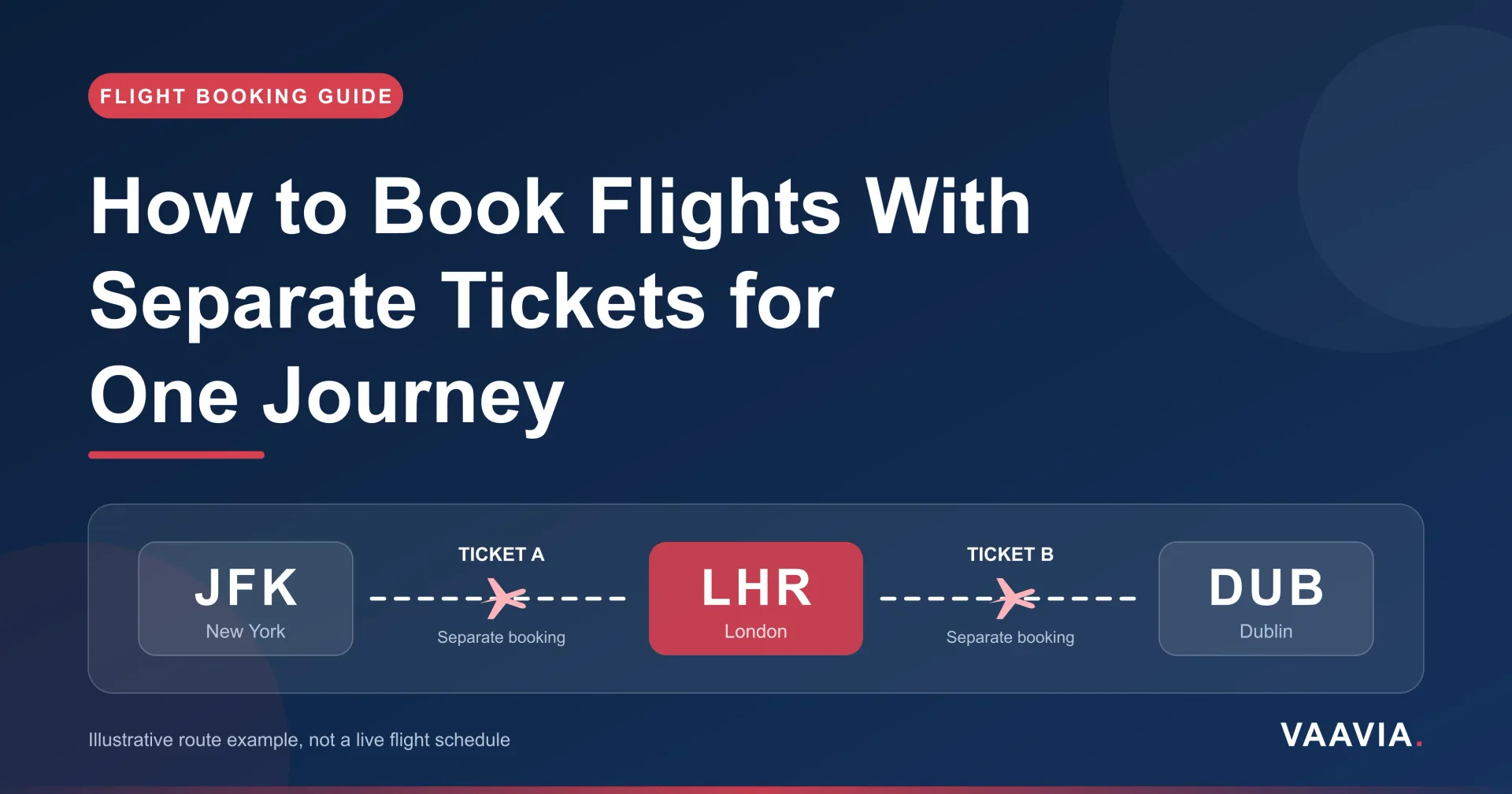
How to Book Flights With Separate Tickets for One Journey
Planning one journey using separately booked flights? Learn how separate tickets work, what to check before booking, and how to organize your travel connections.
- Published
- Updated
- Read time
- 13 min
- Views
- 19
Planning an international trip sometimes involves more than one flight reservation. Instead of booking the entire journey under a single ticket, some travelers choose to purchase two or more flights separately to reach their final destination.
For example, if you are traveling from New York to Singapore, you might consider booking one flight from New York to Tokyo and another separate flight from Tokyo to Singapore. Both flights are part of the same overall journey, but each may have its own booking reference, ticket conditions, baggage arrangements, and check-in requirements.
This arrangement is commonly known as booking flights with separate tickets. It can be useful when planning journeys involving multiple destinations, different airports, or independently arranged travel segments. However, it also requires additional preparation because the connection between separately booked flights may not be protected in the same way as a connection booked under one ticket.
Before making reservations, you should understand how separate tickets work, how to organize your travel dates, how much transfer time to allow, and what could happen if your first flight is delayed.
In this guide, we explain how to book flights with separate tickets for one journey, what to check before confirming your reservations, and how to decide whether separate tickets are suitable for your travel plans.
What Does Booking Flights With Separate Tickets Mean?
Booking flights with separate tickets means purchasing two or more flight segments independently instead of arranging the complete journey under one ticket.
Each flight reservation may have its own:
Booking confirmation or reference number.
Electronic ticket number.
Payment and reservation details.
Baggage allowance.
Check-in requirements.
Change and cancellation conditions.
Consider a traveler flying from Los Angeles to Singapore through Tokyo.
Example: One International Journey With Two Separate Tickets
Travel Segment | Departure | Arrival | Booking Arrangement |
|---|---|---|---|
First flight | Los Angeles (LAX) | Tokyo (NRT) | First separate ticket |
Second flight | Tokyo (NRT) | Singapore (SIN) | Second separate ticket |
Illustrative route only. This is not a live flight schedule or confirmed connection.
In this example, the traveler books Los Angeles to Tokyo independently and then makes another reservation for Tokyo to Singapore.
Although both flights form one overall journey, the reservations may be treated independently.
This means the traveler must understand how the transfer works and whether the first flight's ticket conditions provide any protection for the separately booked onward flight.
How to Book Flights With Separate Tickets Step by Step
Booking separate flights requires coordinating every part of your journey. Instead of focusing only on the first available flight, plan the complete route before confirming your reservations.
1. Decide Your Departure City, Connecting City, and Final Destination
Start by identifying where your journey begins and where you ultimately want to travel.
Next, consider whether an intermediate city is necessary or whether you want to include a stopover during your trip.
For example, possible international route combinations include:
New York to London to Dubai.
Los Angeles to Tokyo to Singapore.
Chicago to Frankfurt to Mumbai.
Miami to Madrid to Rome.
These are examples of route structures, not confirmed flight options.
When selecting a connecting city, consider its airport facilities, transportation arrangements, immigration requirements, and onward flight options.
Also confirm whether the connecting flights use the same airport. Two airports serving the same city may be located far apart and require additional transportation.
Your route should work as a complete journey rather than simply offering convenient individual flight segments.
2. Select Your First Flight Reservation
Once you have planned your route, identify the flight from your departure city to your intermediate destination.
Before making the first reservation, review the complete flight information.
Important details include:
Departure airport and terminal.
Travel date and local departure time.
Arrival airport and expected arrival time.
Cabin and checked baggage allowance.
Ticket change and cancellation conditions.
Passenger name and travel document details.
Whether the flight arrives at the airport you need for your onward journey.
For example, if your first flight arrives at Tokyo Narita Airport (NRT), check whether your second flight also departs from Narita or from Haneda Airport (HND).
Do not assume that airports serving the same city are interchangeable.
A transfer between different airports can involve additional travel time, transportation costs, and immigration requirements.
3. Arrange Your Second Flight Separately
After reviewing the first reservation, identify the onward flight to your final destination.
The second flight should fit into your complete travel schedule.
Check the following details:
Departure date and time.
Departure airport and terminal.
Check-in opening and closing times.
Boarding time.
Baggage drop-off deadline.
Online check-in availability.
Ticket change and cancellation conditions.
Pay particular attention to the time between your first flight's scheduled arrival and the second flight's departure.
Remember that the scheduled arrival time is not necessarily the time you will be ready to check in for your next flight. You may still need to leave the aircraft, collect baggage, complete immigration procedures, and reach another departure area.
4. Allow Enough Time Between Separately Booked Flights
This is one of the most important considerations when arranging a separate-ticket journey.
When flights are booked independently, the second reservation may not automatically accommodate delays affecting the first flight.
Suppose your first flight arrives later than expected. You may have less time to complete the transfer and reach the next departure gate.
Before selecting your second flight, consider:
Aircraft arrival and disembarkation time.
Immigration and passport control.
Checked baggage collection.
Customs procedures.
Terminal transfers.
Airport transportation, if required.
Check-in and baggage drop deadlines.
Security screening and boarding time.
A transfer involving baggage collection and a new check-in process is different from a connection where you remain inside the international transit area.
There is no single safe connection duration for every airport or itinerary. Check the airport's transfer requirements and the onward flight's check-in deadlines before booking.
For additional information about independently arranged airport transfers, read our guide to understanding self-transfer flights.
5. Understand How Self-Transfers Work
A self-transfer means that the traveler is responsible for arranging the transfer between independently booked flights.
Depending on the airport and reservation arrangements, the process may involve:
Leaving the arriving aircraft.
Collecting checked baggage.
Completing immigration procedures, if required.
Moving to the departure terminal or airport.
Checking in for the next flight.
Dropping off checked baggage.
Passing through security.
Reaching the boarding gate before the deadline.
Not every separate-ticket journey requires every step. The actual process depends on the airport, ticket arrangements, baggage agreements, and immigration rules.
Before booking, understand whether you can complete the transfer without leaving the international transit area or whether you must enter the connecting country.
6. Confirm Baggage Collection and Transfer Arrangements
Baggage arrangements can make a significant difference when booking flights separately.
Do not assume that your checked baggage will automatically travel to your final destination simply because both flights are part of the same overall journey.
Depending on the airlines, airport, ticket arrangements, and applicable baggage agreements, you may need to collect your luggage after the first flight and check it in again for the second flight.
For example, a traveler flying from Chicago to Frankfurt and then taking a separately booked flight from Frankfurt to Mumbai should confirm whether the baggage can be checked through to Mumbai.
Before making reservations, check:
Whether baggage is transferred between the flights.
Whether baggage collection is required.
Whether customs clearance is necessary.
Whether a new baggage drop is required.
Whether the second ticket includes the baggage allowance you need.
Whether additional baggage charges may apply.
Always verify these details with the relevant airline or booking provider before confirming your journey.
7. Check Transit Visa and Immigration Requirements
International separate-ticket journeys can involve additional immigration considerations.
Depending on your nationality, passport, connecting country, airport, and transfer arrangement, you may need permission to enter the connecting country.
This is particularly important if you need to:
Collect your checked baggage.
Leave the international transit area.
Change airports.
Stay overnight outside the transit area.
Complete a new check-in process in the public departure area.
Some airports offer international transit arrangements that allow eligible passengers to remain airside. Other itineraries may require passengers to pass through immigration.
A transit visa or entry permission may be necessary in certain situations.
Check official government immigration information for every country involved in your journey before purchasing your tickets.
Do not assume that a visa for your final destination automatically satisfies the transit requirements of another country.
8. Review the Conditions of Both Tickets
Each independently booked reservation may have different conditions.
For example, the first ticket might allow certain changes, while the second ticket may have different cancellation or rebooking rules.
Before confirming either reservation, review:
Flight change conditions.
Cancellation eligibility.
Refund rules.
Missed-flight conditions.
Baggage allowance.
Passenger name correction rules.
Check-in deadlines.
Applicable additional charges.
One important point is that a delay on your first separately booked flight does not automatically mean the second flight will be changed without additional charges.
Understand the responsibilities associated with both reservations before making payment.
Single-Ticket Connection vs Separate-Ticket Journey
A single-ticket connection and a separate-ticket journey can both involve multiple flights, but their booking arrangements are different.
Comparison | Single-Ticket Connection | Separate-Ticket Journey |
|---|---|---|
Booking structure | Complete journey arranged under one ticket | Flights purchased independently |
Reservation details | Usually coordinated as one itinerary | May have separate booking references |
Flight segments | Multiple segments may be included | Each reservation has its own ticket conditions |
Connection arrangements | Governed by the applicable ticket conditions | More transfer planning may be required |
Baggage | Through-checking may be available | Must be confirmed separately |
Missed connection | Rebooking assistance may apply under applicable conditions | Second ticket may not protect against delays on the first |
Check-in | Multiple segments may be handled together | Separate check-in may be required |
Travel planning | Generally more coordinated | Requires additional preparation |
The actual arrangements depend on the ticket conditions, airlines, and airports involved.
A single-ticket itinerary is not a guarantee that every possible disruption will be covered, and separate tickets do not automatically mean that baggage transfer or other coordinated arrangements are unavailable. Always check the specific conditions.
What Happens If You Miss Your Second Flight?
Missing an onward flight is one of the main risks associated with separate-ticket travel.
Imagine that your first flight from Los Angeles to Tokyo is delayed. You arrive later than expected and still need to collect your baggage, complete the necessary airport procedures, and check in for your Tokyo-to-Singapore flight.
If you cannot complete those steps before the second flight's deadline, you may miss your onward departure.
The airline operating the second flight may treat the reservation according to its own missed-flight and ticket conditions.
Depending on those conditions, you may need to:
Contact the airline operating the second flight.
Check whether a change is permitted.
Review cancellation and refund eligibility.
Arrange a new flight if necessary.
Consider additional accommodation or transportation.
Do not assume that the airline operating your first flight will automatically arrange a replacement for a separately booked second flight.
This is why allowing sufficient transfer time is particularly important.
When Does Booking Separate Flight Tickets Make Sense?
Separate tickets may be worth considering for certain travel arrangements, but they are not suitable for every traveler.
When Your Journey Includes Multiple Destinations
If you are visiting several cities during one trip, separate reservations may allow you to arrange each journey segment independently.
For example, you may plan to travel from New York to London, spend several days there, and then continue to Paris.
When You Want to Include a Stopover
A planned stopover is different from a short airport connection.
If you want to spend one or more nights in an intermediate city, separate tickets may allow you to organize the travel dates around your stay.
When You Need Different Departure Airports
Some itineraries may involve arriving at one airport and departing from another.
However, this requires additional planning for ground transportation, immigration, and transfer time.
When Your Travel Schedule Is Flexible
Travelers with flexible schedules may find it easier to organize independent flight segments and allow additional time between reservations.
When You Understand the Additional Responsibilities
Separate-ticket travel may be more manageable when you understand baggage arrangements, airport procedures, visa requirements, and the consequences of a missed connection.
If you have strict arrival deadlines or cannot afford to miss your onward flight, compare the risks carefully before choosing this arrangement.
Separate Tickets vs Multi-City Flight Booking
Separate-ticket journeys and multi-city flight bookings are sometimes confused because both can involve multiple destinations.
However, they describe different booking arrangements.
A multi-city itinerary generally allows travelers to include several destinations within one overall booking request. Depending on the booking and ticket conditions, the flight segments may be issued together.
Separate-ticket travel involves independently arranged flight reservations, which may have different booking references and conditions.
Example of a Multi-City Journey
Flight | Route |
|---|---|
Flight 1 | New York to London |
Flight 2 | London to Paris |
Flight 3 | Paris to New York |
Example of a Separate-Ticket Journey
Flight | Booking Arrangement |
|---|---|
Flight 1 | New York to London booked independently |
Flight 2 | London to Paris booked separately |
Flight 3 | Paris to New York booked under another reservation |
The most suitable arrangement depends on the number of destinations, travel dates, connection requirements, and ticket conditions.
If your trip includes several destinations, explore multi-city flight booking assistance to understand the available booking arrangements.
Common Mistakes to Avoid When Booking Separate Flight Tickets
Even travelers who plan their routes carefully can overlook important details.
Here are some mistakes worth avoiding before confirming your reservations.
Booking flights too close together
A short transfer may not provide enough time for baggage collection, immigration, check-in, and security procedures.
Assuming baggage will transfer automatically
Separate reservations do not guarantee that checked baggage will reach your final destination without collection and rechecking.
Ignoring airport changes
Arriving at one airport and departing from another can require additional transportation and entry permissions.
Overlooking transit visa requirements
Your nationality and connecting country's immigration rules may determine whether you can complete the transfer.
Not checking the second flight's check-in deadline
Check-in and baggage drop-off may close well before the scheduled departure time.
Assuming both tickets are protected together
A delay on one independently booked flight may not provide protection for the next reservation.
Forgetting about overnight connections
A long transfer may require accommodation, meals, and additional transportation planning.
Not reviewing the conditions of both reservations
Different tickets can have different change, cancellation, and missed-flight conditions.
How to Plan a Separate-Ticket Journey for an International Trip
Before purchasing separate reservations, organize your travel information in one place.
For a journey from the United States to an international destination, consider the following planning process:
Write down your departure city and final destination.
Identify the connecting city and airport.
Compare the first and second flight schedules.
Confirm whether both flights use the same airport.
Check whether baggage collection is required.
Review transit visa and entry requirements.
Calculate the time needed for the complete transfer.
Check the check-in deadline for the onward flight.
Review the conditions of both tickets.
Keep your reservation confirmations and travel documents accessible.
This process helps you understand the complete journey before making a financial commitment.
If your plans involve multiple destinations rather than a simple connection, compare whether a multi-city itinerary may be a more appropriate option.
How Vaavia Can Help With Your Flight Booking Requirements
Arranging a journey with separate flight tickets can involve comparing different flight segments, travel dates, connecting airports, and ticket conditions.
Vaavia is an independent travel agency providing flight booking assistance for travelers planning domestic and international journeys.
If you are organizing a trip with multiple destinations or independently arranged flight segments, you can discuss your requirements with Vaavia before proceeding with your reservation.
To make your enquiry more useful, prepare the following information:
Departure city and airport.
Final destination.
Intermediate cities you want to visit.
Preferred departure and return dates.
Number of passengers.
One-way or round-trip requirement.
Whether you need a multi-city itinerary.
Baggage and travel preferences.
Any special travel requirements.
Sharing these details can help clarify the type of flight arrangements you want to consider.
You can also explore Vaavia's multi-city flight booking assistance if your travel plans include multiple destinations.
Planning a Journey With Multiple Flight Tickets?
Discuss your departure city, destinations, preferred dates, and flight booking requirements with Vaavia.
Vaavia – Independent Travel Agency
Phone: +1 (844) 449 0844
Website: https://vaavia.com/
Email: support@vaavia.com
Final Thoughts
Booking flights with separate tickets for one journey can provide another way to organize trips involving multiple destinations, connecting cities, and independently arranged flight segments.
However, separate reservations also require additional attention to transfer time, baggage arrangements, immigration procedures, and ticket conditions.
Before confirming your flights, review the entire itinerary and understand what happens if one segment is delayed, changed, or missed.
Do not choose separate tickets simply because the route appears convenient. Consider the complete transfer process, the responsibilities associated with each reservation, and whether a multi-city or single-ticket itinerary would better match your travel plans.
With careful preparation and a clear understanding of each booking, you can make a more informed decision about arranging your international journey.
Frequently Asked Questions
Can you book separate tickets for one journey?
Yes. You can buy each leg of a trip as its own ticket, even with different airlines. The main difference is that each ticket has its own rules, so you are responsible for the time between flights.
Is it cheaper to book flights separately?
Sometimes, but not always. Fares vary by route, date and airline. Before deciding, add baggage fees, a possible hotel night, airport transfers and change costs, then compare the total with a single ticket for the same trip.
What happens if I miss my second flight on a separate ticket?
It depends on the airline, the fare and the ticket rules. When tickets are booked separately, the second airline is generally not required to rebook you if your first flight is late. Contact that airline as early as possible to ask about your options.
How much layover time do I need between separate tickets?
There is no single answer. Minimum connection times vary by airport, terminal and airline. You need extra time if you must change terminals, collect and re-check bags, clear immigration or go through security again. A longer buffer, or an overnight stay, is safer.
Will my bags be transferred automatically between separate tickets?
Usually not. Bags are often checked only to the end of each ticket, so you may need to collect them and check in again. Confirm the baggage rules with each airline before you travel.
Is booking separate tickets the same as a self-transfer?
They are closely related. A self-transfer means you move between flights on your own, usually with separate bookings. You can read more in our guide to understanding self-transfer flights.
Do I need a transit visa if I book separate tickets?
It depends on your nationality, the country you pass through and whether you leave the airport's secure area. Always check requirements with official government sources and the airlines before you book.