




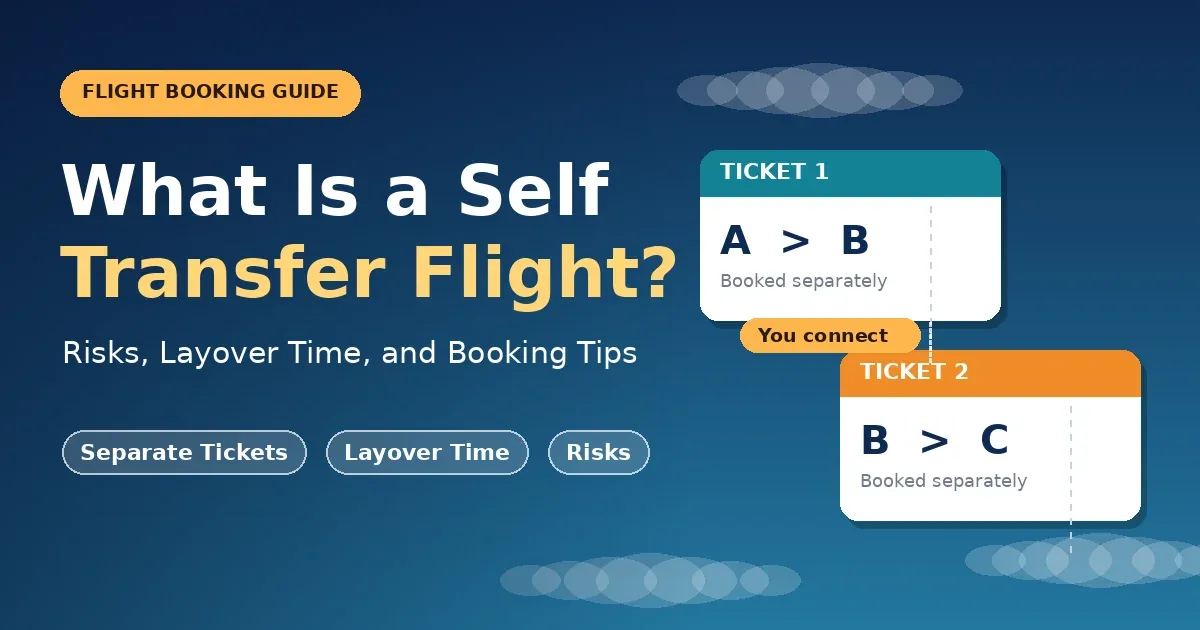
What Is a Self Transfer Flight? Risks, Layover Time, and Booking Tips
Updated for 2026-2027 travel. Airline rules, fares, and baggage policies change often, so confirm the details with each airline before you book. Two separate flight tickets with a gap between them and the text "What Is a Self Transfer Flight, Risks, Layover Time, and Booking Tips"
Last updated Oct 25, 2026
What is a self-transfer flight? It is a trip where you book two or more flights on separate tickets and connect between them on your own. Because each ticket is its own booking, the airlines do not treat your flights as one journey. That can unlock lower fares and more routes, especially on long-distance trips, but it also moves the risk onto you. This guide explains how it works, how much layover time you need, and how to book safely. If you are comparing routes for a long trip abroad, you can browse international flights first to see what a single ticket would cost.
If you want a refresher on what happens when a connection goes wrong, read our guide on a missed connecting flight before you decide whether a self-transfer is right for you.
By the end of this article, you will know the real risks, the layover time to aim for, and how to decide if the savings are worth it.
On This Page
- What Is a Self Transfer Flight? A Simple Definition
- How a Self-Transfer Works
- Self-Transfer vs Single Ticket
- Why Do Travelers Choose Self-Transfers?
- The Main Risks of a Self-Transfer Flight
- What Happens If Your First Flight Is Late?
- How Much Layover Time Do You Need?
- Baggage: What to Expect
- Passports, Visas, and Transit Rules
- Self-Transfer Booking Tips
- Is a Self-Transfer Cheaper?
- When a Self-Transfer Is a Bad Idea
- Insurance and Flexible Fares
- Common Mistakes to Avoid
- Quick Checklist
- Plan Your Trip With Vaavia
- Frequently Asked Questions
What Is a Self-Transfer Flight? A Simple Definition
A self-transfer flight is a connection that you book yourself using separate tickets, often with different airlines. For example, you might buy one ticket from your home city to a hub airport and a second ticket from that hub to your final destination. Between the two flights, you are responsible for getting from one to the other: collecting your bags if needed, checking in again, clearing security, and boarding on time.
The key detail is the booking structure. On a normal connecting itinerary, both flights are on one ticket, so the airline knows you are connecting and has a duty to help if the first flight is late. On a self-transfer, each flight is a separate contract. If flight one is delayed and you miss flight two, the second airline generally has no obligation to rebook you, because as far as it can see, you simply did not show up.
How a Self-Transfer Works
A self-transfer follows a simple pattern.
- You book flight one from your starting city to a connecting airport.
- You book flight two from that airport to your final destination, on a separate ticket.
- You land at the connecting airport and, in most cases, collect your checked bags.
- You check in again for flight two, drop your bags, and go through security.
- You board flight two and continue your trip.
Everything between landing and boarding is on you, including the time it takes and the risk that something goes wrong.
Self-Transfer vs Single Ticket
The two options can look similar on a map, but they behave very differently when plans change.
Comparison table of a single ticket and a self-transfer flight
| Feature | Single Ticket | Self-Transfer |
|---|---|---|
| Booking | One booking, one itinerary | Two or more separate bookings |
| Delay on flight 1 | Airline usually rebooks you | Second airline may not help |
| Checked bags | Often sent through to the end | You usually collect and recheck |
| Check-in and security | Often done once | May need to repeat at the hub |
| Price | Can be higher | Can be lower, but not always |
| Risk level | Lower | Higher, you carry the risk |
A single ticket costs more in many cases because you are paying for protection. A self-transfer can save money, but only if everything goes to plan.
Why Do Travelers Choose Self-Transfers?
People book self-transfers for a few good reasons:
- Lower fares: Two separate tickets, especially on different airlines, can cost less than one combined itinerary.
- More route options: You can combine airlines that do not sell tickets together, or fly into a smaller airport that is cheaper.
- Flexible planning: You can choose each leg separately and build your own schedule.
- Longer stopovers: A self-transfer makes it easy to stay a night or two in the connecting city.
- Budget airline access: Low-cost carriers often sell only point-to-point flights, so connecting them means booking separately.
The Main Risks of a Self-Transfer Flight
The savings come with real trade-offs. Know them before you click book.
- No protection from a missed connection: If flight one is late, flight two will not wait for you, and the airline may not rebook you for free.
- You may need to buy a new ticket: If you miss the second flight, a replacement ticket can cost much more than your original savings.
- Baggage must be rechecked: Your bags usually will not transfer automatically, so you must collect them and check in again.
- Extra security and border steps: You may need to clear security again, and in some cases immigration or customs.
- Different rules on each ticket: Each airline has its own baggage fees, check-in cut-offs, and change policies.
- Refunds are not guaranteed: If one flight is cancelled, the other ticket may not be refundable.
- Stress and time pressure: Even a smooth connection can feel rushed if the layover is too short.
What Happens If Your First Flight Is Late?
This is the scenario that matters most. Here is how the two options compare.
Comparison of what happens when the first flight is late on a single ticket and on a self-transfer
On a single ticket, the airline knows about your connection. If a delay makes you miss it, the airline usually rebooks you on the next available flight, and your bags are normally transferred for you. Extra help, such as meals or a hotel, depends on the cause of the delay and the airline's policy.
On a self-transfer, the second airline sees a separate booking. If you miss it, you may have to buy a new ticket or pay a change fee, and a refund or rebooking is not guaranteed. This is why layover time matters so much.
How Much Layover Time Do You Need?
There is no official minimum for a self-transfer, since you are not protected by any connection rules. The safest approach is to leave more time than you think you need. These are suggested buffers, not official rules.
Suggested layover time for self-transfer flights by situation
- Same airport, domestic: Aim for about 3 to 4 hours or more. You need time to land, collect bags, recheck them, and clear security.
- Same airport, international: Aim for about 4 to 6 hours or more. Passport control, customs, and long check-in lines can take a while.
- Different airports or terminals: Aim for about 6 hours or more, or plan an overnight stay. Add ground transfer time and a safety margin for traffic.
- Strict check-in cut-off: Some airlines close bag drop 60 minutes or more before departure. Check the cut-off for your second flight and add extra time.
When in doubt, a longer layover is safer. Many experienced travelers also schedule a full overnight stay between flights, so a delay does not cause a chain reaction.
Baggage: What to Expect
Baggage is one of the biggest differences between a self-transfer and a single ticket.
- Collect and recheck: In most cases, you pick up your checked bags at the connecting airport and check them in again for flight two.
- Two sets of fees: Each airline can charge its own baggage fees, and the rules for size, weight, and number of bags may differ.
- Carry-on only can help: Traveling with only a carry-on can make a self-transfer faster and avoid the recheck, though some budget fares limit carry-on size, so check the rules.
- Check-in cut-offs: Bag drop usually closes before boarding, so count that time into your layover.
- Lost or delayed bags: If your bag is delayed on flight one, it may not reach you in time for flight two, since the airlines are not linked.
Passports, Visas, and Transit Rules
Self-transfers can involve extra paperwork, especially on international trips.
- Entry requirements: Because you collect bags and recheck, you may need to formally enter the connecting country, which can mean passport control and sometimes a visa.
- Transit rules: Some countries require a transit visa even for a short stop. Check the rules for every country on your route.
- Passport validity: Many countries require your passport to be valid for several months beyond your travel dates.
- Proof of onward travel: You may be asked to show your second ticket when you check in for the first flight.
- Names must match: Names on both tickets must match your passport exactly. A name change or correction after booking can be difficult and costly.
Always check official government sources for the latest entry rules.
Self-Transfer Booking Tips
A few habits can lower the risk and make the trip smoother.
Six tips for booking a self-transfer flight safely
- Leave a long layover. More time protects you from delays, long lines, and bag recheck.
- Book flight one earlier in the day. If you miss a connection, there are usually more backup options on a morning schedule than on a late-night one.
- Check both baggage rules. Each airline has its own fees, sizes, and check-in cut-offs.
- Check entry requirements. Passport, visa, and transit rules may apply at the connecting airport.
- Consider flexible fares. A changeable second ticket can help if your plans shift.
- Look at travel insurance. Check whether a policy covers missed connections on separate tickets.
- Save both confirmations. Keep your itineraries, booking numbers, and contact details in one place.
- Check your flight status. Look at the first flight before you leave for the airport, and again when you land.
Is a Self-Transfer Cheaper?
Often it is, but not always. Whether you save money depends on the route, season, airlines, and how much extra time you build in.
- Compare the full cost. Add both fares, baggage fees, and any hotel night or ground transport you need.
- Compare with a single ticket. Search the same route as one itinerary and compare the total.
- Count the cost of failure. If you miss the second flight, a replacement ticket can wipe out the savings.
- Think about your time. A long layover saves risk but costs hours. Decide if the savings are worth it.
If the savings are small, a single ticket is usually the safer choice.
When a Self-Transfer Is a Bad Idea
A self-transfer may not be right if:
- The layover is short. A few hours between separate tickets is risky.
- You are traveling with young children or anyone who needs extra time.
- You have a fixed deadline, such as a wedding, a cruise departure, or a work event.
- The trip is expensive and non-refundable. A missed connection costs more.
- You are flying into a busy hub in winter or peak season, when delays are more likely.
- You are not comfortable managing two bookings and any problems that arise.
In these cases, paying a little more for a single ticket can be worth the protection.
Insurance and Flexible Fares
Travel insurance and flexible fares can reduce the risk of a self-transfer, but they are not a perfect solution.
- Missed connection cover: Some travel insurance policies cover missed connections, but many exclude separate tickets or have conditions. Read the policy carefully.
- Flexible second ticket: A fare that allows changes can help if you miss the connection, but you may still pay a fare difference.
- Credit card benefits: Some cards include travel protection. Check the details and exclusions.
- Refund policy: Review each airline's refund and change rules before you pay.
Ask your insurer in advance whether a self-transfer is covered, and get the answer in writing if you can.
Common Mistakes to Avoid
- Booking a very short layover. This is the most common and costly mistake.
- Ignoring the baggage recheck. Forgetting the time it takes to collect and check bags can make you miss your flight.
- Skipping entry rules. A visa or passport problem can stop you at the border.
- Assuming airlines will help. On separate tickets, neither airline is responsible for the connection.
- Booking the last flight of the day. If you miss it, you may be stuck overnight with no easy options.
- Not checking both airlines' cut-offs. Check-in deadlines can differ.
- Mismatched names. A typo on one ticket can cause problems at check-in.
- Ignoring the total cost. A cheap fare can become expensive once you add fees and risks.
Quick Checklist
Before you book a self-transfer flight, ask yourself:
- Is the savings worth the extra risk?
- Is my layover long enough, with a safety margin?
- Do I understand the baggage rules for both tickets?
- Do I meet the entry and transit requirements for every country?
- Are the names on both tickets exactly the same as on my passport?
- Do I have a backup plan, such as a flexible fare or a later flight?
- Have I checked what my insurance covers?
If you can answer yes to all seven, a self-transfer may be a smart choice.
Plan Your Trip With Vaavia
A self-transfer flight can save money and open up more routes, but only if you plan carefully and leave plenty of time. Compare it with a single ticket, count the full cost, and read the rules for both airlines before you pay.
Vaavia can help you compare flights, understand fare rules, and find a route that fits your plans. Browse current flights, or request a callback to talk through your itinerary with a booking specialist.
Frequently Asked Questions
What is a self transfer flight?
A self transfer flight is a trip where you book two or more flights on separate tickets and connect between them yourself. The airlines do not treat the flights as one journey.
Is a self-transfer flight risky?
It can be. If your first flight is late and you miss the second, the second airline is generally not obligated to rebook you, and you may need to buy a new ticket.
How much layover time do I need for a self-transfer?
There is no official minimum. Many travelers aim for at least 3 to 4 hours on domestic connections and 4 to 6 hours or more on international ones, and longer if the airports or terminals are different.
Do I have to collect my bags on a self-transfer?
Usually yes. Because the tickets are separate, your bags are not normally checked through, so you collect and recheck them for the second flight.
Is a self-transfer cheaper than a single ticket?
Sometimes. It can be cheaper, but you should compare the full cost, including baggage fees and any extra hotel or transport, against a single ticket.
What happens if I miss my second flight on a self-transfer?
You may have to buy a new ticket or pay a change fee, and a refund is not guaranteed. This is why a long layover and flexible fares can be worth the cost.
Do I need a visa for a self-transfer?
It depends on the country and your passport. Because you often collect your bags and recheck, you may need to enter the country formally. Check official government sources for each stop.
Does travel insurance cover a self-transfer?
Some policies cover missed connections, but many have conditions or exclusions for separate tickets. Read the policy carefully and ask your insurer before you buy.